Does Creatine Timing Matter? What the Evidence Says
Does creatine timing matter? We weigh pre- vs post-workout, loading phases, and the daily dose against the actual evidence — and what it doesn't show.

You can find lengthy debates about whether creatine works better before or after training, complete with stopwatch-level precision. Here's the contrarian truth up front: the timing question is one of the least important things about creatine. The dose, the consistency, and the fact that you take it at all dwarf the question of when.
The short answer on timing
Researchers have directly tested pre- versus during- versus post-exercise creatine, and the honest summary is that the science isn't settled — but the differences are small enough to barely matter. A 2021 review in Nutrients put it plainly: "Emerging evidence suggests greater benefits when creatine is consumed after exercise compared to pre-exercise, although methodological limitations currently preclude solid conclusions" [1]. In other words, post-workout might have a slight edge, but the data aren't strong enough to make a rule out of it.
The most-cited timing study randomized older adults (50–71) to creatine before training, after training, or placebo for 32 weeks. Post-exercise creatine produced greater lean-tissue gains (Δ 3.0 ± 1.9 kg) than placebo (Δ 0.5 ± 2.1 kg) [2]. But notice what didn't differ: strength gains were nearly identical whether creatine was taken before or after (leg press: 36.6 kg before vs 40.8 kg after) [2]. The authors concluded that creatine improves strength "independent of the timing of ingestion" [2].
If you want the full picture on the compound itself, our deep dive on creatine covers the broader evidence base.
Why timing barely moves the needle
Creatine works by saturating your muscle's intramuscular creatine stores [1]. Once those stores are topped off, they stay topped off as long as you keep taking your daily dose. This is fundamentally different from a stimulant or a pump aid that acts acutely — creatine is a saturation play, not a same-session play.
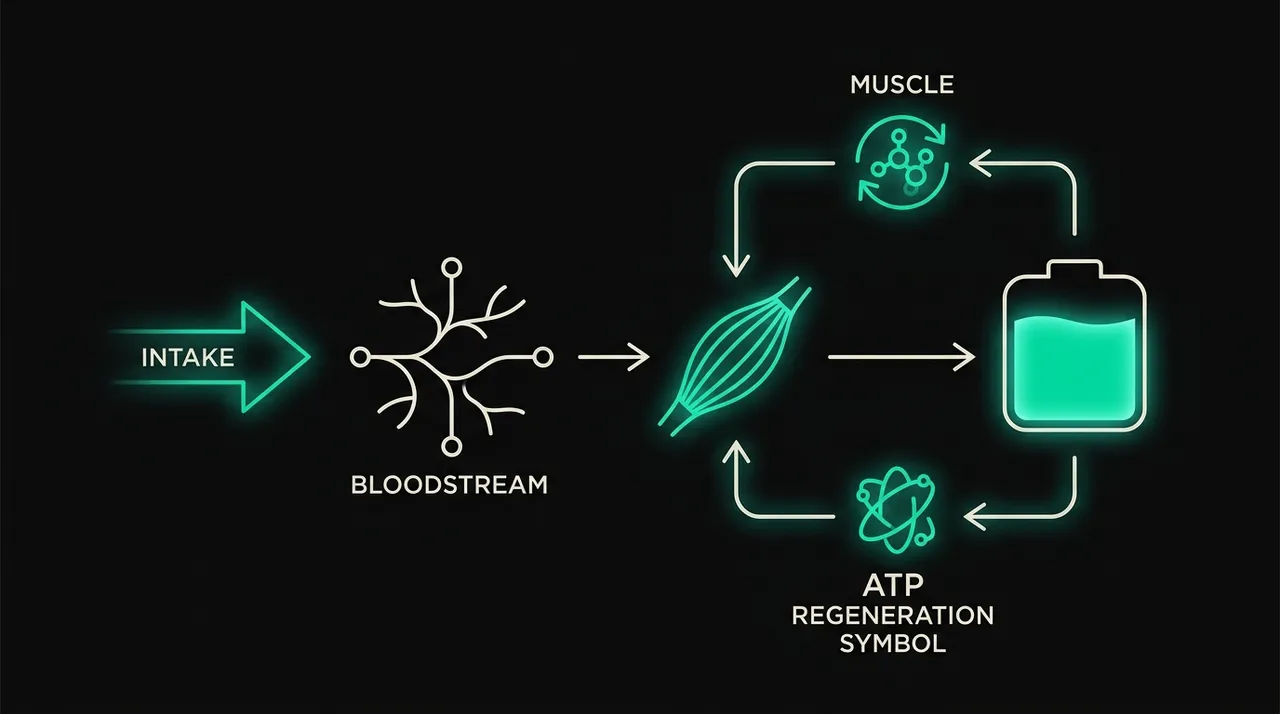
The review notes that the size of the intramuscular increase depends on factors like baseline muscle creatine, type II fiber content, habitual dietary intake, and aging [1] — none of which are the clock on your wall. When your muscle is already saturated, shifting your dose 90 minutes earlier or later doesn't meaningfully change the reservoir it draws from.
This is the opposite of nutrients where timing genuinely matters. With certain minerals, for example, co-ingestion changes absorption — which is exactly why we wrote about calcium and iron timing. Creatine simply doesn't behave that way.
Pre vs post vs anytime: a comparison
| Strategy | What the evidence shows | Practical verdict |
|---|---|---|
| Pre-workout | Comparable strength gains to post [2] | Fine; convenient if you mix it in a pre-shake |
| Post-workout | Possibly slightly greater lean mass in older adults [2]; "emerging" edge [1] | Reasonable default, but not a dealbreaker |
| Any time of day | Saturation is the driver; consistency matters most [1] | Totally valid — pick the time you'll actually remember |
The takeaway: take it when you'll be consistent. A dose you remember every day beats a "perfectly timed" dose you skip on rest days.
Loading phase and daily dose
A loading phase — roughly 20 g/day split into 4 doses for 5–7 days — saturates muscle stores faster. But it's optional. A steady 3–5 g/day of creatine monohydrate reaches the same saturation in about 3–4 weeks; loading just shortens the wait [1][3].
For most people the practical protocol is simple:
- Maintenance dose: 3–5 g of creatine monohydrate daily [3]
- Optional loading: ~20 g/day for 5–7 days if you want faster saturation, then drop to maintenance
- Rest days: still take it — you're maintaining a reservoir, not fueling a single session
- What to take it with: food, a shake, or water — your call
The International Society of Sports Nutrition position stand on female athletes recommends 3–5 g/day, noting both iron and creatine are "highly efficacious for female athletes," and adds that post-menopausal women may benefit from higher doses (~0.3 g/kg/day) for bone, mental health, and skeletal muscle outcomes [3].
Creatine's value also shows up across resistance-training meta-analyses for strength and hypertrophy [5][6][7][8] and even in broader metabolic-performance reviews [4] — none of which hinge on hitting a precise clock time.
What the evidence does NOT show
Let's surface the gaps honestly:
- It does not show that a specific timing window is required for results. Strength gains were equivalent before vs after training [2].
- The post-workout "advantage" is not confirmed — the 2021 review explicitly flags that "methodological limitations currently preclude solid conclusions" [1].
- There is no solid mechanistic explanation that timing changes muscle creatine uptake; the review notes "physiological and mechanistic data are lacking" for timing claims [1].
- Creatine is not a treatment, cure, or preventive for any disease. The evidence here is about supporting training adaptations like strength and lean mass [2][5][6], not clinical outcomes.
- It does not show you must load. Loading speeds saturation; it doesn't raise your ceiling [1].
Myth-check
Myth: "You have to take creatine within the anabolic window right after training or it's wasted."
Reality: Creatine isn't an acute, session-dependent nutrient — it works by keeping muscle stores saturated over time [1]. The one study showing a post-workout edge found it only for lean mass in older adults, with strength gains unaffected by timing [2]. The bigger lever is daily consistency and an adequate dose, not the minute hand. If you've ever fussed over timing the way people debate whether beta-alanine actually works or whether L-citrulline helps with pumps, creatine is the one supplement where you can genuinely relax about the clock.
Want more of this evidence-first approach? Browse our supplement science topics.
FAQ
Should I take creatine before or after my workout?
The difference is minor. One study in older adults found slightly greater lean-mass gains with post-workout dosing [2], but strength gains were similar regardless of timing [2]. Total daily intake and consistency matter far more.
Do I need a creatine loading phase?
No. Loading (~20 g/day for 5–7 days) saturates muscle stores faster, but 3–5 g/day reaches the same saturation in about 3–4 weeks [1][3]. Both end at the same place.
What's the standard creatine monohydrate dose?
Most evidence supports 3–5 g per day [3]. Post-menopausal women may benefit from higher doses (~0.3 g/kg/day) for muscle and other outcomes [3].
Does it matter what I take creatine with?
Not much. Creatine works whether taken with food, a shake, or alone. The key variable is daily consistency so muscle stores stay saturated [1].
Related reading
- Creatine: the full evidence breakdown
- Creatine and alcohol: what the mouse data shows
- Creatine in a protein shake: what the evidence shows
- Does beta-alanine actually work?
- Does L-citrulline help with pumps?
- Calcium and iron timing
- Supplement science topics
References
- Ribeiro F et al. (2021). Timing of Creatine Supplementation around Exercise: A Real Concern?. Nutrients. PubMed · doi:10.3390/nu13082844
- Candow DG et al. (2015). Strategic creatine supplementation and resistance training in healthy older adults. Applied physiology, nutrition, and metabolism = Physiologie appliquee, nutrition et metabolisme. PubMed · doi:10.1139/apnm-2014-0498
- Sims ST et al. (2023). International society of sports nutrition position stand: nutritional concerns of the female athlete. Journal of the International Society of Sports Nutrition. PubMed · doi:10.1080/15502783.2023.2204066
- Jaramillo AP et al. (2023). Effectiveness of Creatine in Metabolic Performance: A Systematic Review and Meta-Analysis. Cureus. PubMed · doi:10.7759/cureus.45282
- Wang Z et al. (2024). Effects of Creatine Supplementation and Resistance Training on Muscle Strength Gains in Adults <50 Years of Age: A Systematic Review and Meta-Analysis. Nutrients. PubMed · doi:10.3390/nu16213665
- Burke R et al. (2023). The Effects of Creatine Supplementation Combined with Resistance Training on Regional Measures of Muscle Hypertrophy: A Systematic Review with Meta-Analysis. Nutrients. PubMed · doi:10.3390/nu15092116
- Dos Santos EEP et al. (2021). Efficacy of Creatine Supplementation Combined with Resistance Training on Muscle Strength and Muscle Mass in Older Females: A Systematic Review and Meta-Analysis. Nutrients. PubMed · doi:10.3390/nu13113757
- Zhang H et al. (2025). Effects of creatine supplementation on muscle strength gains-a meta-analysis and systematic review. PeerJ. PubMed · doi:10.7717/peerj.20380
These statements have not been evaluated by the FDA. This content is educational only and is not intended to diagnose, treat, cure, or prevent any disease, and is not a substitute for professional medical advice.
Evidence Brief
Get supplement timing and safety notes as they ship.
Monthly evidence briefs. No hype, no disease claims, no influencer supplement stacks.