Does L-Citrulline Help With Pumps? The Evidence
Does L-citrulline actually boost your pump? We break down the nitric oxide science, dosing, and what the research does (and doesn't) show.

You've probably seen L-citrulline headlining nearly every pre-workout on the shelf, sold on one promise: a bigger, harder pump. The pitch is seductive and the mechanism is real, but the gap between "plausible mechanism" and "proven effect" is where most marketing quietly lives. Here's what the actual literature says.
What the "pump" actually is
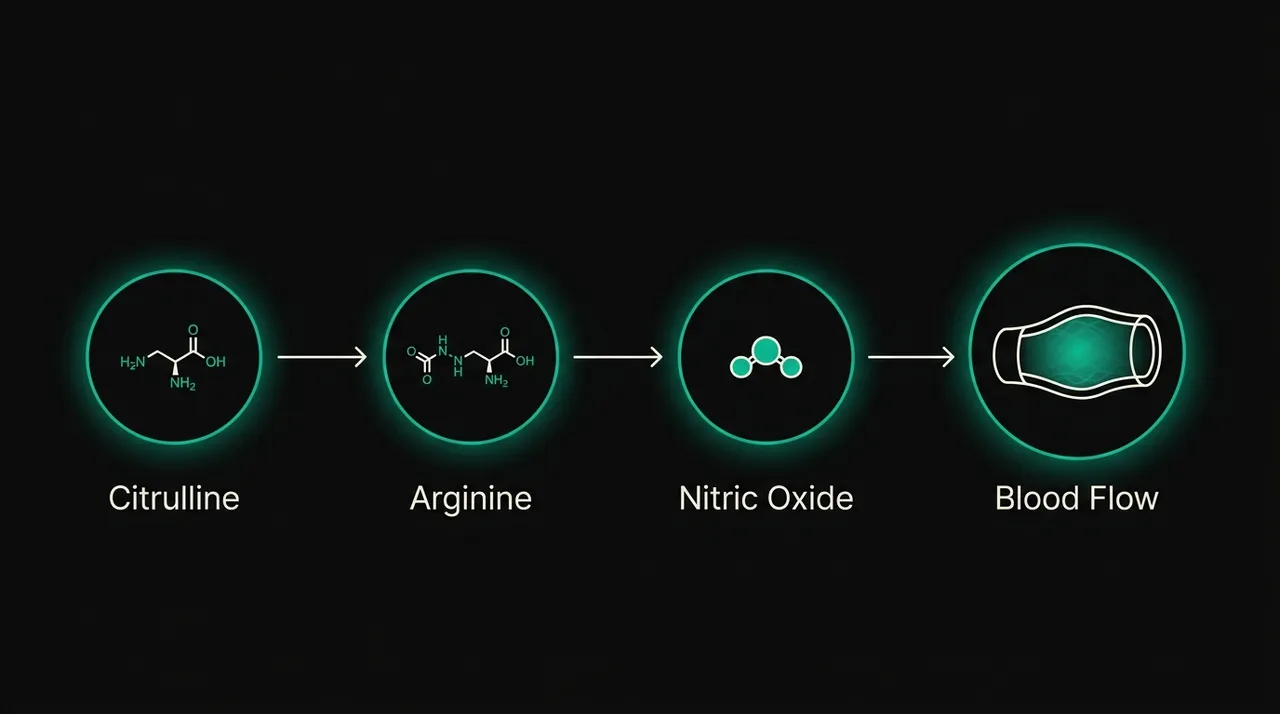
The pump is transient vascular engorgement of working muscle: more blood flowing in than is draining out during a set. The theory behind citrulline is that it increases nitric oxide (NO), the signaling molecule that relaxes vascular smooth muscle and dilates blood vessels [1]. More dilation, more flow, bigger pump. NO is generated through a nitric-oxide-synthase pathway that depends on precursors like L-arginine and nitrates, "with L-citrulline serving as an effective precursor of L-arginine" [1].
How citrulline becomes nitric oxide
Here's the elegant part. You might assume the smart move is to just take arginine directly. It isn't. Oral L-arginine is "largely ineffective at increasing NO synthesis" because it gets heavily extracted by the gut and liver before it reaches your bloodstream [4]. L-citrulline sidesteps this: it "is not quantitatively extracted from the gastrointestinal tract... or liver and its supplementation is therefore more effective at increasing l-arginine levels and NO synthesis" [4].
In other words, the most reliable way to raise arginine is to not take arginine. Oral citrulline (and citrulline malate) has been shown to raise plasma citrulline and arginine, along with total nitrate and nitrite concentrations [3].
L-Citrulline vs Citrulline Malate vs L-Arginine
| Feature | L-Citrulline | Citrulline Malate | L-Arginine |
|---|---|---|---|
| Raises plasma arginine | Yes, bypasses gut/liver clearance [4] | Yes [3] | Poorly, heavily extracted first-pass [4] |
| Raises NO precursors (nitrate/nitrite) | Yes [3] | Yes [3] | Limited [4] |
| Dosing clarity | High, known citrulline content | Lower, ratio inconsistencies between brands [2] | High |
| Performance evidence | Mixed but promising [3] | Equivocal [2] | Weak [4] |
| Added component | None | Malate (possible ammonia/ATP role) [2] | None |
The key takeaway: citrulline malate adds malic acid, which might aid ammonia homeostasis or ATP production [2], but its research is hampered by "quality control issues" where labeled citrulline-to-malate ratios don't match reality [2]. If you want a known dose of citrulline, plain L-citrulline is the more transparent option.
Citrulline dosage for pumps
Most acute studies have leaned on "a single acute 8 g dose" of citrulline malate before resistance exercise or cycling [2], while L-citrulline studies typically use several grams. One practical wrinkle: cardiometabolic and vascular benefits in the literature often emerge with consistent supplementation rather than a one-off dose [4]. A reasonable, evidence-informed approach:
- L-citrulline: ~3-6 g daily, taken consistently
- Citrulline malate: ~8 g pre-workout, but verify the citrulline content [2]
- Timing: Daily use may matter more than nailing a pre-workout window
- Stacking: Citrulline has been studied alongside nitrates, antioxidants, and BCAAs [3]
What the evidence does NOT show
This is where honesty separates science from sales copy.
- It does not reliably prove a bigger acute pump. Despite blood flow being the headline mechanism, "evidence supporting acute improvements in vasodilation and skeletal muscle tissue perfusion after supplementation is scarce and inconsistent" [3].
- Citrulline malate's performance benefit is unsettled. The 8 g protocol "has produced equivocal results," leaving its efficacy "ambiguous" [2].
- It is not a treatment for any medical condition. While low arginine bioavailability is associated with cardiovascular risk [5], supplementing citrulline is not shown to treat or prevent disease; blood-pressure work in pre-/hypertensive adults is described as "promising," not conclusive [4].
- More NO precursor does not guarantee more strength. The reviews call for better-controlled studies before drawing firm performance conclusions [1][2][3].
Myth check: "If I feel a pump, the supplement is working"
A visible pump is a real physiological event, but feeling pumped after a pre-workout doesn't isolate citrulline as the cause: caffeine, training volume, hydration, and sodium all influence perceived fullness. The mechanistic case for citrulline is genuinely strong [1][4]; the human pump-specific data simply hasn't caught up to the hype [3]. Plausible is not the same as proven.
FAQ
Does L-citrulline help with pumps?
L-citrulline raises plasma arginine and nitric oxide precursors, which may support vasodilation and blood flow to working muscle [1][3]. That said, direct human evidence for acute increases in muscle perfusion is scarce and inconsistent, so the pump effect is plausible but not firmly proven [3].
What's the difference between L-citrulline and citrulline malate?
L-citrulline is the pure amino acid; citrulline malate pairs it with malic acid. Both raise plasma citrulline and arginine [3], but citrulline malate research is muddied by inconsistent citrulline-to-malate ratios and equivocal results [2]. For a known citrulline dose, plain L-citrulline is the cleaner choice.
What is the best citrulline dosage for pumps?
Acute studies commonly use around 8 g of citrulline malate or several grams of L-citrulline [2][3]. Effects may build with consistent daily use rather than a single dose, so taking it daily, not just on training days, is reasonable [4].
Does citrulline actually work better than arginine?
Oral L-arginine is largely ineffective at raising NO because the gut and liver clear most of it; L-citrulline bypasses that first-pass extraction and raises arginine more effectively [4]. So as a precursor, citrulline has the better pharmacology, though performance outcomes remain mixed [3].
Related reading
- L-Citrulline: uses, dosing, and the evidence
- Citrulline and blood pressure: what the research says
- Circulation support: the supplement evidence
- More evidence-based supplement science
References
- Gonzalez AM et al. (2023). Supplementation with Nitric Oxide Precursors for Strength Performance: A Review of the Current Literature. Nutrients. PubMed · doi:10.3390/nu15030660
- Gough LA et al. (2021). A critical review of citrulline malate supplementation and exercise performance. European journal of applied physiology. PubMed · doi:10.1007/s00421-021-04774-6
- Gonzalez AM et al. (2020). Effects of Citrulline Supplementation on Exercise Performance in Humans: A Review of the Current Literature. Journal of strength and conditioning research. PubMed · doi:10.1519/JSC.0000000000003426
- Allerton TD et al. (2018). l-Citrulline Supplementation: Impact on Cardiometabolic Health. Nutrients. PubMed · doi:10.3390/nu10070921
- Tang WH et al. (2009). Diminished global arginine bioavailability and increased arginine catabolism as metabolic profile of increased cardiovascular risk. Journal of the American College of Cardiology. PubMed · doi:10.1016/j.jacc.2009.02.036
These statements have not been evaluated by the FDA. This content is educational only and is not intended to diagnose, treat, cure, or prevent any disease, and is not a substitute for professional medical advice.
Evidence Brief
Get supplement timing and safety notes as they ship.
Monthly evidence briefs. No hype, no disease claims, no influencer supplement stacks.