Does Beta-Alanine Actually Work? The Evidence
Beta-alanine's effect is real but small and specific. Here's what the meta-analyses show, who benefits, dosing, and the tingles explained.

Beta-alanine is one of the few pre-workout ingredients with real meta-analytic support behind it — but the size of that effect is much smaller than the tingling rush on your skin suggests. The honest answer to "does it work" is: yes, in a narrow window, for a specific kind of effort. Let's separate the signal from the marketing.
What beta-alanine actually does
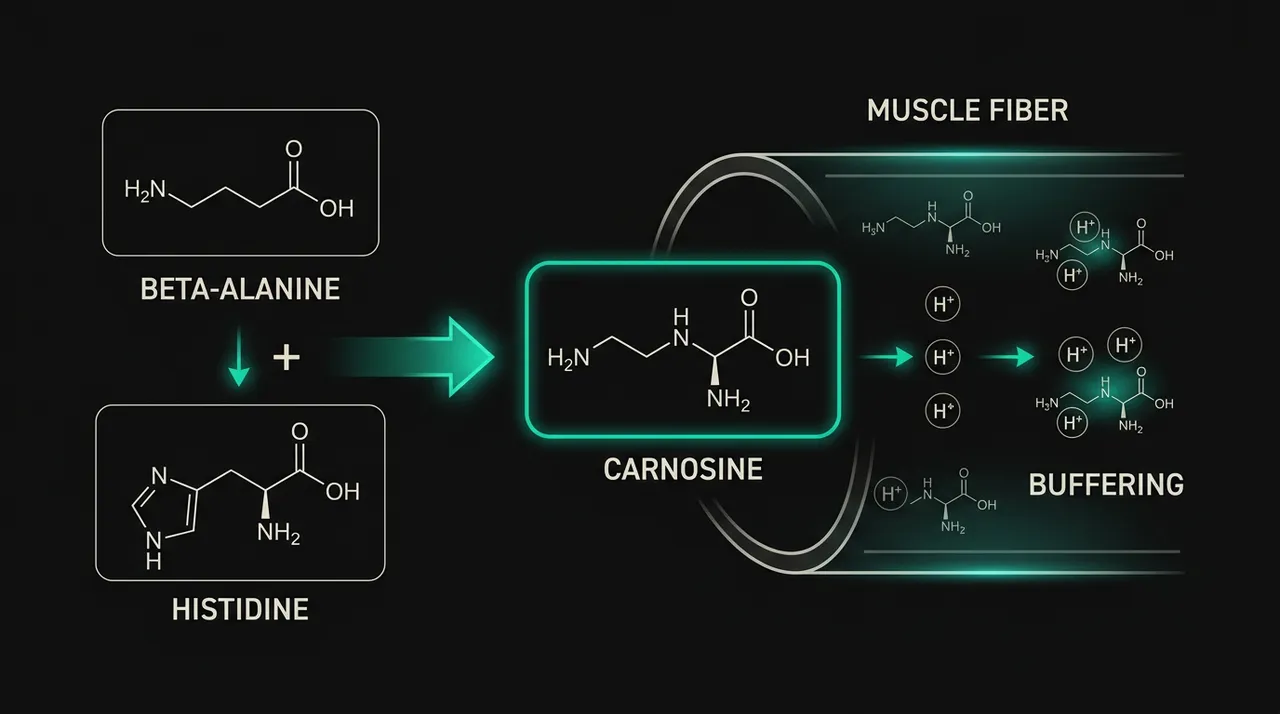
Beta-alanine is a non-essential amino acid. On its own it does almost nothing for performance — its job is to act as the rate-limiting building block for carnosine, a dipeptide your muscles use to buffer the hydrogen ions (acid) that accumulate during hard exercise [2][4]. More dietary beta-alanine means more intramuscular carnosine, and more carnosine means you can resist the drop in muscle pH that contributes to fatigue [7].
The histidine half of carnosine is rarely the bottleneck; beta-alanine availability is what limits synthesis, which is why supplementing it raises carnosine and dietary histidine alone generally does not [8]. If you want the deeper mechanistic breakdown and sourcing notes, see our beta-alanine ingredient page.
How big is the effect, really?
This is where most articles oversell it. The largest meta-analysis to date pooled 40 studies and 1,461 participants and found a significant but small overall effect size of 0.18 (95% CI 0.08 to 0.28) [1]. An earlier meta-analysis put the median improvement at about 2.85% in an exercise measure when a median of 179 g total had been ingested [2].
The effect isn't uniform — it's heavily moderated by how long the effort lasts:
- Exercise lasting 60–240 seconds improved significantly [2].
- Exercise lasting over 240 seconds also improved, though less robustly [2].
- Exercise lasting under 60 seconds showed no benefit [2].
A 2024 meta-analysis in trained young men echoed this, reporting an overall effect size of 0.39 favouring beta-alanine, with the strongest signal for 4–10 minute maximal efforts (effect size 0.55) [4]. Two patterns recur across the literature: beta-alanine helps capacity (how long you can sustain effort) more reliably than performance (a fixed time-trial), and the benefit clusters in the roughly 1–10 minute range [1][2].
Beta-alanine vs creatine vs other ergogenics
Beta-alanine is consistently listed among the small handful of supplements with robust evidence — alongside creatine, nitrates, caffeine, and protein [5]. But these tools don't do the same job.
| Supplement | Primary mechanism | Best for | Typical effect |
|---|---|---|---|
| Beta-alanine | Raises muscle carnosine, buffers H+ [4][7] | ~1–10 min high-intensity efforts [1][2] | Small (~2.85%; ES 0.18–0.39) [1][2][4] |
| Creatine | Increases phosphocreatine / ATP turnover [5] | Short sprints, strength/power [5] | Well-established for strength/power [5] |
| Nitrates / caffeine | Blood flow / CNS stimulation [5] | Endurance / overall output [5] | Varies by context [5] |
Combining creatine and beta-alanine is popular, and a 2025 systematic review of 7 RCTs (263 participants) found the combination enhanced high-intensity and repeated-bout performance versus either alone — but it did not beat creatine alone for maximal strength, and effects on body composition and aerobic capacity were equivocal or absent [3]. So they're complementary, not redundant.
If your goal is pumps and blood flow rather than acid buffering, that's a different lever entirely — see whether L-citrulline helps with pumps.
Practical dosing
What the dosing data actually support:
- Total accumulated dose matters most. Carnosine loading is a slow, chronic process — single big servings don't help acutely.
- Aim for roughly 4–6 g per day consistently. One meta-analysis found a higher dose band of 5.6–6.4 g/day produced a reliable effect (ES 0.35), and meaningful effects appeared by 4 weeks of supplementation [4].
- Co-supplementation with sodium bicarbonate produced the largest effect size versus placebo in the pooled data, suggesting the buffering systems stack [1].
- Split your doses (e.g. 2 g taken 2–3 times daily) or use a sustained-release form to minimise the tingles [6].
Timing is far less fussy than for minerals — unlike the calcium and iron timing issue, beta-alanine doesn't need to be isolated from other nutrients. Consistency beats clock-watching.
What the evidence does NOT show
Be clear-eyed about the limits:
- It does not improve efforts under 60 seconds — a single max lift or a 100 m sprint is the wrong use case [2].
- It does not reliably build muscle or change body composition. Even combined with creatine, body-composition results were equivocal [3].
- It does not improve aerobic endurance markers like VO2max, lactate threshold, or time to exhaustion when added to creatine [3].
- It does not increase maximal strength beyond what creatine provides alone [3].
- The overall effect is small and population-averaged — training status did not significantly moderate the response in the largest analysis, but individual variation is real [1].
- Beta-alanine does not treat, cure, or prevent any condition. It is an ergogenic aid studied in healthy populations, not a therapy.
Myth-check: the tingles
Myth: "The tingling means it's working."
The prickling, flushing sensation on your face, neck, and hands is paraesthesia — a harmless, transient side effect from beta-alanine acting on sensory nerve receptors [6]. It is dose-dependent and tells you nothing about whether your muscle carnosine is rising. You can blunt or eliminate it with smaller split doses or sustained-release formulations while still getting the full ergogenic benefit [6]. Conversely, a product that makes you tingle hard isn't necessarily more effective — it just delivered a larger single bolus.
For more myth-checks and methodology, browse our supplement science library.
FAQ
Does beta-alanine actually work?
Yes, but modestly. Meta-analyses show a small overall effect size (~0.18) that grows for exercise lasting roughly 1–10 minutes [1][2]. It does little for efforts under 60 seconds [2].
Why does beta-alanine make me tingle?
That harmless prickling is paraesthesia, caused by beta-alanine binding to skin nerve receptors. It's dose-related and avoidable with smaller split doses or sustained-release forms [6]. It is not a sign the product is working.
What is the right beta-alanine dosage?
The evidence supports roughly 4–6 g per day taken consistently for at least 4 weeks; one analysis found 5.6–6.4 g/day produced reliable effects [4][6]. Total accumulated dose matters more than any single serving.
Beta-alanine vs creatine — which should I take?
They use different mechanisms and aren't competitors. Creatine boosts short, powerful efforts; beta-alanine buffers acid in the 1–10 minute range. Combining them may enhance high-intensity and repeated-bout performance but doesn't beat creatine alone for maximal strength [3][5].
Related reading
- Beta-alanine ingredient overview
- Does L-citrulline help with pumps?
- Supplement science library
- Calcium and iron timing
- Magnesium glycinate vs citrate vs oxide
References
- Saunders B et al. (2017). β-alanine supplementation to improve exercise capacity and performance: a systematic review and meta-analysis. British journal of sports medicine. PubMed · doi:10.1136/bjsports-2016-096396
- Hobson RM et al. (2012). Effects of β-alanine supplementation on exercise performance: a meta-analysis. Amino acids. PubMed · doi:10.1007/s00726-011-1200-z
- Ashtary-Larky D et al. (2025). Effects of Creatine and β-Alanine Co-Supplementation on Exercise Performance and Body Composition: A Systematic Review. Nutrients. PubMed · doi:10.3390/nu17132074
- Georgiou GD et al. (2024). Effect of Beta-Alanine Supplementation on Maximal Intensity Exercise in Trained Young Male Individuals: A Systematic Review and Meta-Analysis. International journal of sport nutrition and exercise metabolism. PubMed · doi:10.1123/ijsnem.2024-0027
- Antonio J et al. (2024). The Top 5 Can't-Miss Sport Supplements. Nutrients. PubMed · doi:10.3390/nu16193247
- Trexler ET et al. (2015). International society of sports nutrition position stand: Beta-Alanine. Journal of the International Society of Sports Nutrition. PubMed · doi:10.1186/s12970-015-0090-y
- Boldyrev AA et al. (2013). Physiology and pathophysiology of carnosine. Physiological reviews. PubMed · doi:10.1152/physrev.00039.2012
- Brosnan ME et al. (2020). Histidine Metabolism and Function. The Journal of nutrition. PubMed · doi:10.1093/jn/nxaa079
These statements have not been evaluated by the FDA. This content is educational only and is not intended to diagnose, treat, cure, or prevent any disease, and is not a substitute for professional medical advice.
Evidence Brief
Get supplement timing and safety notes as they ship.
Monthly evidence briefs. No hype, no disease claims, no influencer supplement stacks.