Creatine and Alcohol: The Mouse Data Is Worse Than You Think
Animal studies show creatine exacerbates ethanol-induced liver damage. No human trials exist. Here's what the evidence actually says.
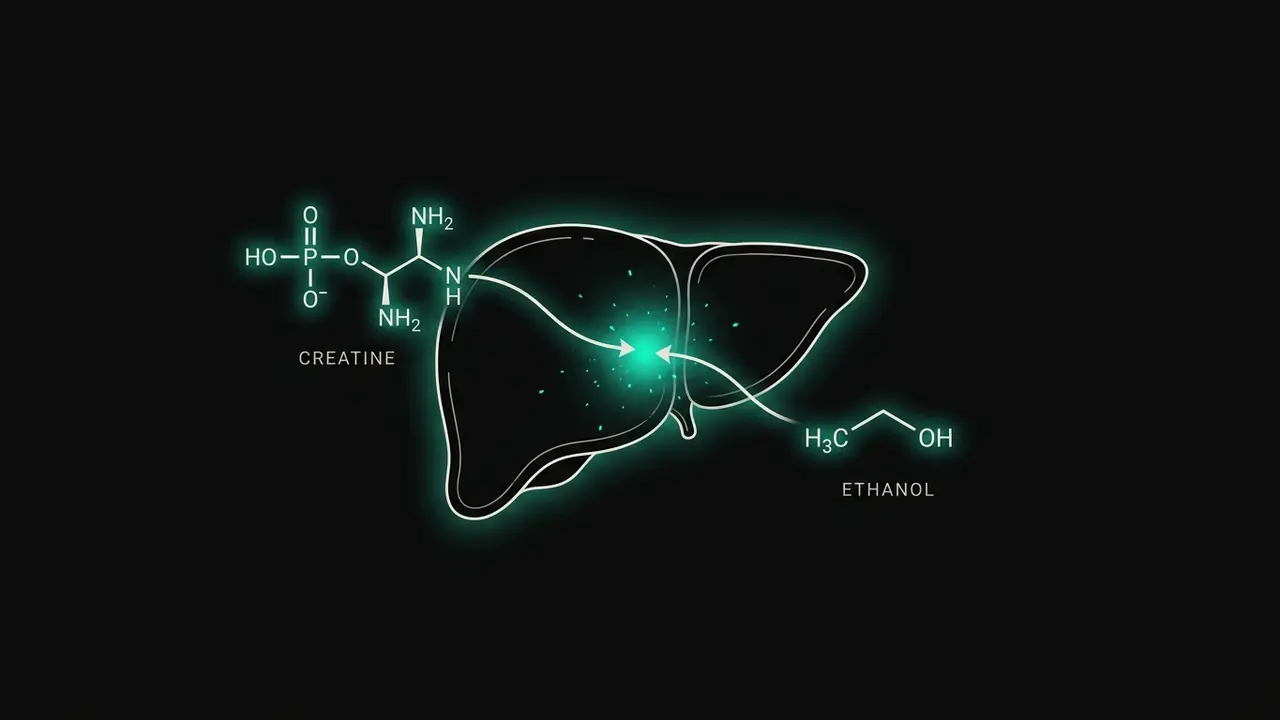
The popular belief is straightforward: creatine builds muscle, alcohol is an occasional social indulgence, and the two can coexist without consequence. The reality from the trials is more interesting, and more honest. Every study examining creatine alongside ethanol has been conducted in rodents, and the most direct evidence shows that creatine supplementation worsened alcoholic liver damage in mice [5][6]. No human trial has tested this combination. If you are taking creatine monohydrate and drinking regularly, the absence of human safety data is itself the most important fact.
What the science actually says
Marinello et al. (2022): in mice, eight animals per group received either control diet, ethanol diet, or ethanol diet plus creatine monohydrate (1% w/v in diet). Creatine up-regulated genes related to ethanol metabolism, oxidative stress, inflammation, and lipid synthesis. The combination group showed increased liver fat accumulation, higher histopathological scores, and elevated oxidative damage markers compared with ethanol alone [5]. This is the most directly relevant study, and its finding is unambiguous: creatine made alcoholic liver disease worse in this model (animal data: hypothesis, not proof).
Marinello et al. (2019): in mice, creatine supplementation exacerbated ethanol-induced hepatic damage [6]. This earlier study from the same group established the direction of effect before the 2022 mechanistic follow-up (animal data: hypothesis, not proof).
The same 2022 study also tested creatine against a high-fat diet (non-alcoholic model). Here, creatine protected against fatty liver progression, attenuating fat accumulation and liver damage [5]. The divergent outcomes within a single paper make the point sharply: context determines whether creatine helps or harms the liver.
Lang et al. (1999): in rats maintained on an alcohol-containing diet for 14 weeks, chronic alcohol reduced lean body mass and decreased gastrocnemius and psoas muscle weights. Mechanistically, alcohol decreased eIF2B activity in fast-twitch muscle and altered eIF4E availability, impairing translation initiation [1] (animal data: hypothesis, not proof).
Preedy et al. (1988, acute): in rats injected with ethanol (75 mmol/kg), fractional rates of skeletal muscle protein synthesis fell by 25 to 30% within 150 minutes, compared with a 5 to 20% reduction in liver [2] (animal data: hypothesis, not proof).
Preedy et al. (1988, chronic): in rats fed ethanol for 6 weeks (36% of calories), fractional and absolute rates of skeletal muscle protein synthesis were reduced by 13 to 30% [3] (animal data: hypothesis, not proof).
None of these studies were conducted in humans. The entire evidence base is preclinical.
How creatine may influence alcohol-related liver stress
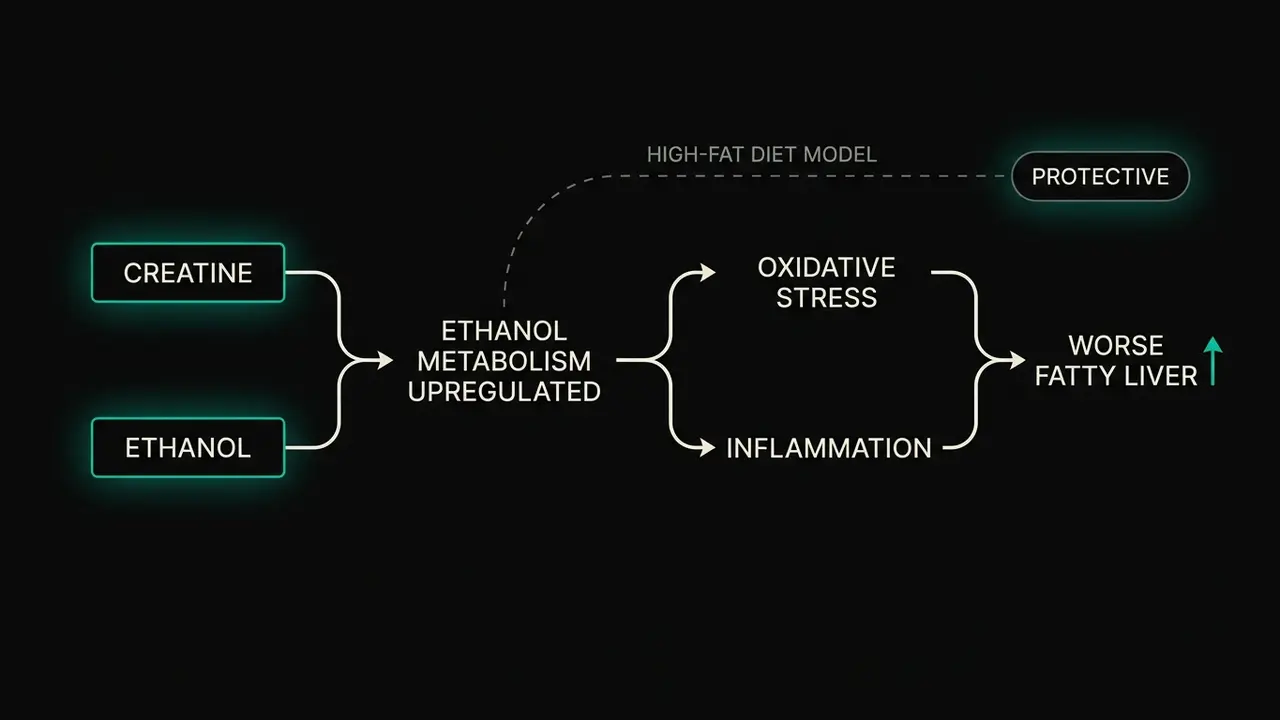
The 2022 Marinello study identified a plausible mechanism: creatine up-regulated key genes related to ethanol metabolism, which increased oxidative stress and inflammatory mediators, ultimately worsening steatosis [5]. The authors proposed that the exacerbating effects relate to oxidative stress and inflammation-mediated up-regulation of ethanol metabolism [5]. Separately, glycine serves as a direct precursor for creatine synthesis [4], meaning creatine loading may alter one-carbon metabolism pathways that intersect with hepatic methylation demands during alcohol processing.
| Condition (mouse model) | Creatine effect | Key outcome |
|---|---|---|
| High-fat diet (NAFLD model) | Protective | Attenuated liver fat accumulation and damage [5] |
| Ethanol exposure (ALD model) | Exacerbating | Increased steatosis, oxidative damage, inflammation [5][6] |
Practical dosing
The studied dose in the mouse exacerbation model was 1% creatine monohydrate by weight in diet [5]. Human equivalent dosing is not established from these studies. Standard creatine monohydrate supplementation in humans typically uses 3 to 5 g daily [7]; there is no RDA because creatine is not an essential nutrient. Label literacy matters: some products list the creatine monohydrate salt weight while others list the free-creatine weight, so check which one you are comparing.
If you have existing kidney disease, standard guidance is to consult a clinician before supplementing with creatine, as renal clearance of creatinine is the primary monitoring concern. The interaction checker in the EverPrime app tracks 41 documented supplement-medication and supplement-supplement interactions, including timing considerations relevant to hepatic load.
What the evidence does NOT show
It does not show that creatine treats, cures, or prevents any disease. These are structure/function findings from preclinical models.
- It does not show creatine is safe with alcohol in humans. The only direct combination data is from mice, and it shows harm [5][6].
- It does not show a safe waiting period. No study tested temporal separation of creatine dosing and alcohol consumption.
- It does not show that occasional drinking negates creatine's muscle benefits in humans. The protein synthesis suppression data comes from rats given chronic or acute ethanol at high doses [1][2][3].
- It does not show creatine protects the liver during alcohol use. The protective effect was observed only in the non-alcoholic fatty liver model [5].
Myth-check
Claim: "Creatine and alcohol cancel each other out, but neither is harmful." Reality: In mice, the combination was not neutral; it was actively worse for the liver than alcohol alone [5][6]. The "cancellation" framing understates the risk suggested by preclinical data. No human data confirms safety.
FAQ
Is it safe to take creatine and drink alcohol on the same day?
No human trials have tested this combination. In mice, creatine supplementation exacerbated ethanol-induced liver steatosis and damage [5][6]. Standard guidance is to avoid combining them until human data exists.
How long after taking creatine can I drink alcohol?
No study in the reviewed literature establishes a safe waiting period. Creatine saturates muscle stores over days to weeks, so a single timing gap is unlikely to eliminate overlap [5].
Does alcohol cancel out creatine's muscle benefits?
In rats, chronic alcohol reduced skeletal muscle protein synthesis by 13 to 30% [3] and acute ethanol reduced it by 25 to 30% [2]. Whether creatine offsets this in humans is untested.
Related reading
- Creatine monohydrate: full supplement guide
- Does creatine timing actually matter?
- Creatine in a protein shake: what the evidence shows
- EverPrime getting started guide
- Supplement science topic hub
- Myth-busting: supplement edition
- Performance and recovery conditions
References
- Lang CH, Wu D, Frost RA, Jefferson LS, Kimball SR, Vary TC (1999). Inhibition of muscle protein synthesis by alcohol is associated with modulation of eIF2B and eIF4E. The American Journal of Physiology. https://pubmed.ncbi.nlm.nih.gov/10444422/ doi:10.1152/ajpendo.1999.277.2.E268
- Preedy VR, Duane P, Peters TJ (1988). Comparison of the acute effects of ethanol on liver and skeletal muscle protein synthesis in the rat. Alcohol and Alcoholism. https://pubmed.ncbi.nlm.nih.gov/3390239/
- Preedy VR, Peters TJ (1988). The effect of chronic ethanol feeding on body and plasma composition and rates of skeletal muscle protein turnover in the rat. Alcohol and Alcoholism. https://pubmed.ncbi.nlm.nih.gov/2904820/
- Razak MA, Begum PS, Viswanath B, Rajagopal S (2017). Multifarious beneficial effect of nonessential amino acid, glycine: a review. Oxidative Medicine and Cellular Longevity. https://pubmed.ncbi.nlm.nih.gov/28337245/ doi:10.1155/2017/1716701
- Marinello PC, Cella PS, Testa MTJ, Guirro PB, da Silva Brito WA, Padilha CS, Cecchini AL, da Silva RP, Duarte JAR, Deminice R (2022). Creatine supplementation protects against diet-induced non-alcoholic fatty liver but exacerbates alcoholic fatty liver. Life Sciences. https://pubmed.ncbi.nlm.nih.gov/36220368/ doi:10.1016/j.lfs.2022.121064
- Marinello PC, Cella PS, Testa MTJ, Guirro PB, Brito WAS, Borges FH, Cecchini R, Cecchini AL, Duarte JA, Deminice R (2019). Creatine supplementation exacerbates ethanol-induced hepatic damage in mice. Nutrition. https://pubmed.ncbi.nlm.nih.gov/31265967/ doi:10.1016/j.nut.2019.05.004
- Sims ST, Kerksick CM, Smith-Ryan AE, Janse de Jonge XAK, Hirsch KR, Arent SM, Hewlings SJ, Kleiner SM, Bustillo E, Tartar JL, Starratt VG, Kreider RB, Greenwalt C, Renteria LI, Ormsbee MJ, VanDusseldorp TA, Campbell BI, Kalman DS, Antonio J (2023). International society of sports nutrition position stand: nutritional concerns of the female athlete. Journal of the International Society of Sports Nutrition. https://pubmed.ncbi.nlm.nih.gov/37221858/ doi:10.1080/15502783.2023.2204066
Disclaimer: The statements in this article have not been evaluated by the Food and Drug Administration. This content is for educational purposes only and is not intended to diagnose, treat, cure, or prevent any disease. It is not a substitute for professional medical advice. Consult a qualified healthcare provider before starting or combining any supplement, especially if you have liver or kidney conditions.
Track your supplement timing and check interactions with the EverPrime interaction checker: 41 documented interactions.
Evidence Brief
Get supplement timing and safety notes as they ship.
Monthly evidence briefs. No hype, no disease claims, no influencer supplement stacks.