Calcium and iron do not belong in the same supplement stack slot
Calcium can blunt non-heme iron absorption when they arrive together. Here is the evidence-based spacing rule for multivitamins, mineral stacks, and iron support.
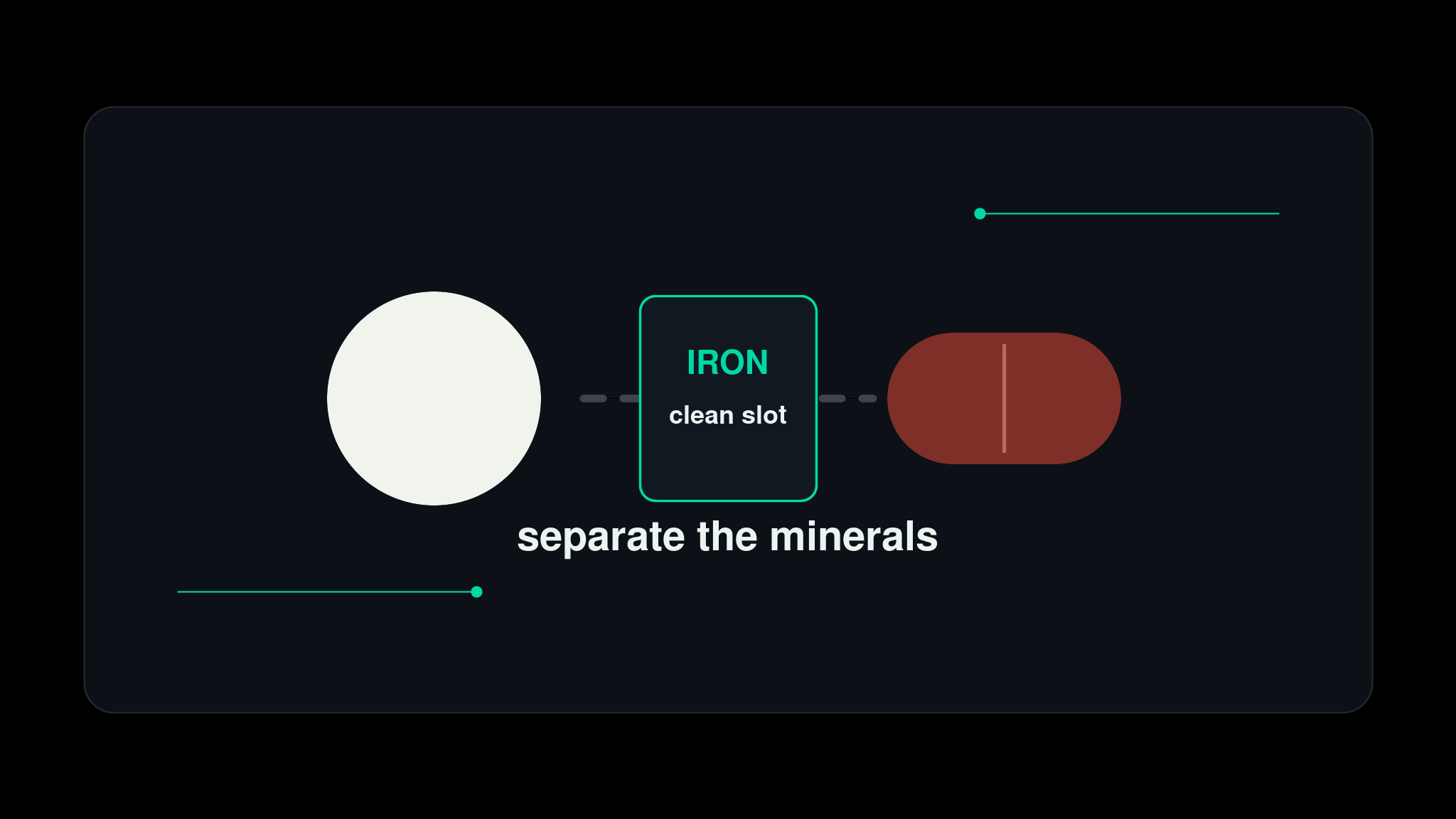
Fast answer: do not take a dedicated iron supplement in the same slot as calcium, a mineral-heavy multivitamin, dairy, or calcium-containing antacids. A practical default is iron in a clean slot, calcium later, with at least 2 hours between them.
Most supplement timing advice focuses on what to take in the morning or at night. That misses the bigger problem: minerals compete inside the same gut window.
Calcium and iron are the cleanest example. Both can be useful. Both can be appropriate in the right person. But if you put them into the same breakfast stack, the calcium may reduce how much iron makes it across the gut wall. That matters most for people using iron to correct low ferritin, women with heavy menstrual losses, vegetarians relying on non-heme iron, endurance athletes, and anyone taking a broad multivitamin that quietly combines minerals into one daily dose.
This is not a "calcium is bad" argument. It is a stack architecture problem.

What the research actually says
Iron absorption is not fixed. It changes based on the iron form, the meal, the person's baseline status, and the other minerals present at the same time.
Non-heme iron, the form found in plant foods and many supplements, is especially sensitive to meal chemistry. Classic human absorption work found that calcium can inhibit both heme and non-heme iron absorption when consumed together, although the size of the effect changes by context (PMID 21462112). A controlled isotope study in women also found that calcium carbonate and calcium phosphate reduced non-heme iron absorption from a meal (PMID 1984334).
The most important detail is timing. Calcium's effect is acute: it matters when calcium and iron are present together in the intestinal absorption window. That makes the intervention simple. You do not need a complex protocol. You need fewer collisions.
Slot design
A cleaner iron day separates blockers
Morning
Iron + vitamin C
clean absorption slot
Lunch
Normal meal
no mineral stack
Dinner
Calcium / vitamin D
away from iron
Bedtime
Magnesium
separate mineral slot
The EverPrime rule: optimize the slot before you optimize the supplement. A good iron product in the wrong slot can underperform a boring iron product in a clean slot.
The practical spacing rule
Use this as the default until a clinician gives you a more specific plan:
| Stack item | Take with iron? | Practical rule |
|---|---|---|
| Calcium supplement | No | Separate by at least 2 hours |
| Dairy or calcium-fortified drink | Usually no | Keep away from the iron slot |
| Mineral-heavy multivitamin | No | Do not use it as the iron dose |
| Magnesium or zinc supplement | Prefer separate | Use a different stack slot |
| Coffee or tea | Prefer separate | Polyphenols can reduce non-heme iron absorption |
| Vitamin C | Often yes | Pair with iron if tolerated |
| Food | Depends | A small non-dairy snack can improve tolerance |
A two-hour gap is a pragmatic minimum. People taking high-dose calcium, calcium antacids, or clinician-directed iron for deficiency often use a wider 3-4 hour separation because the cost of spacing is low and the cost of poor iron response can be high.
Do not turn this into personal medical advice. If iron was recommended because of anemia, pregnancy, inflammatory bowel disease, kidney disease, bariatric surgery, or another medical context, the timing plan should be checked with a clinician.
Why multivitamins are the hidden problem
Many multivitamins look efficient because the label puts everything in one pill. For iron, that can be a weakness.
A typical once-daily multi may include iron, calcium, magnesium, zinc, and sometimes copper in the same serving. That is convenient for adherence, but not necessarily ideal for absorption. Minerals can share transport pathways, bind in the gut, or create a competitive environment where the headline dose on the label is not the same as the absorbed dose.
This is why "contains 18 mg iron" is not enough information. The better question is:
Is the iron dose separated from the minerals that can interfere with the iron slot?
For someone who is not iron deficient and is only using a low-dose multivitamin, this may not matter much. For someone intentionally taking iron, it matters a lot more. Iron support is one of the few supplement categories where the difference between label dose and absorbed dose can change whether the plan is doing its job.
A cleaner daily schedule
Here is a simple structure for someone taking iron, calcium, magnesium, and vitamin D:
| Time | Slot | Why it works |
|---|---|---|
| Morning | Iron + vitamin C, away from dairy if tolerated | Clean iron window |
| Lunch | Normal meal, no dedicated mineral stack | Keeps the iron slot protected |
| Dinner | Vitamin D + calcium with food | Fat-containing meal supports vitamin D; calcium is away from iron |
| Bedtime | Magnesium if used | Separate mineral slot |
This schedule is not universal. Some people tolerate iron better with food. Some need alternate-day iron. Some should not take iron at all unless deficiency is confirmed. The point is the architecture: put iron in its own lane, then place calcium and magnesium elsewhere.
Alternate-day iron changes the equation
Iron timing is also affected by hepcidin, the hormone that helps regulate iron absorption. Human studies suggest that daily iron can raise hepcidin and reduce absorption from subsequent doses, which is one reason alternate-day dosing has been studied for iron repletion strategies (PMID 29032957, PMID 31413088).
That does not mean everyone should take iron every other day. It does mean iron is not a casual "add it to the stack" mineral. Dose frequency, lab status, side effects, and timing all matter.
The conservative supplement-stack interpretation is simple: if you are taking iron intentionally, give it a clean absorption slot and avoid burying it inside a mineral pile.
What to check on your own labels
Use this quick label audit:
Label scan
What a strong supplement label makes easy to verify
Exact form
Compound is named, not hidden behind the nutrient.
Dose per serving
Real daily dose is clear after serving math.
Quality signal
Testing mark, lot path, or certificate exists.
Timing risk
Minerals, caffeine, meals, and medication windows are visible.
- Does your multivitamin include iron and calcium in the same serving?
- Are you taking iron with coffee, tea, dairy, or a calcium-fortified drink?
- Are you taking an antacid near your iron dose?
- Are you taking magnesium, zinc, or calcium in the same morning stack?
- Is your iron plan based on labs, or just a guess?
If the answer to the first four is yes, the timing may be undermining the plan. If the answer to the fifth is "just a guess," pause and get ferritin, hemoglobin, and clinician guidance before using high-dose iron. Too little iron is a problem, but unnecessary iron is not automatically harmless.
Iron is not a general wellness supplement. It is most defensible when there is a documented reason, a clear target, and a follow-up plan.
The EverPrime stack rule
Keep iron away from mineral congestion.
That means:
- Take iron in a clean slot when possible.
- Keep calcium, magnesium, zinc, mineral multis, dairy, and antacids away from that slot.
- Pair vitamin C with iron when appropriate and tolerated.
- Do not use high-dose iron without labs or clinical direction.
- Recheck the plan if ferritin or symptoms do not move as expected.
The goal is not more supplements. It is better execution of the supplements that are actually justified.
Related reading
- Iron Pills for Anemia: The Honest Evidence on What Works
- Magnesium and Calcium Supplements: The Honest Trial Data
- Supplement Science hub
Sources
- Hallberg L, Brune M, Erlandsson M, Sandberg AS, Rossander-Hulten L. Calcium: effect of different amounts on nonheme- and heme-iron absorption in humans. PMID 21462112
- Cook JD, Dassenko SA, Whittaker P. Calcium supplementation: effect on iron absorption. PMID 1984334
- Stoffel NU, Cercamondi CI, Brittenham G, et al. Iron absorption from supplements is greater with alternate day than with consecutive day dosing in iron-deficient anemic women. PMID 31413088
- Moretti D, Goede JS, Zeder C, et al. Oral iron supplements increase hepcidin and decrease iron absorption from daily or twice-daily doses. PMID 29032957
These statements have not been evaluated by the FDA. Not intended to diagnose, treat, cure, or prevent any disease.
Generated with AI assistance. Always verify with a healthcare professional.
Educational information only. Not a substitute for professional medical advice.
Evidence Brief
Get supplement timing and safety notes as they ship.
Monthly evidence briefs. No hype, no disease claims, no influencer supplement stacks.