Beetroot Supplements: Honest Trial Results vs Marketing
Beetroot supplements are heavily marketed for blood pressure and endurance, but the clinical evidence reveals highly specific effects with modest magnitudes.
Beetroot supplements are heavily marketed as an undeniable ergogenic aid and cardiovascular fix-all. The reality from the trials is more interesting, and more honest. Dietary nitrate does have a measurable biological effect — but the magnitude is highly context-dependent. For blood pressure, a 2024 meta-analysis of adults with hypertension found a systolic reduction of -5.31 mmHg, rated low-certainty, with no significant effect on diastolic or 24-hour ambulatory pressure [1]. For exercise, benefits show up in some task types and vanish in others [5]. This is a niche physiological tool, not a universal performance upgrade.
What the science actually says
The research splits into two outcome families: hemodynamics and exercise physiology. Several of the loudest claims wilt when you read the statistical reporting closely.
Blood pressure outcomes
The most comprehensive recent read is a 2024 systematic review and meta-analysis by Grönroos et al., pooling 11 randomized controlled trials (349 patients with hypertension) to test whether beetroot juice (BRJ) can be considered an adjunct to standard care. Daily BRJ produced a significant reduction in clinical systolic blood pressure versus placebo: mean difference -5.31 mmHg (95% CI -7.46 to -3.16; I2 = 64%). There was no significant effect on clinical diastolic pressure or on 24-hour ambulatory outcomes, and the GRADE certainty of evidence was rated low — the authors themselves say to interpret with caution [1].
A 2020 double-blind randomized feasibility trial by Siervo et al. in Tanzania adds color. Forty-seven participants (ages 50-70) were randomized to high-nitrate BRJ (~400 mg nitrate), high-nitrate BRJ plus folic acid, or nitrate-depleted BRJ placebo for 60 days. The BRJ-only arm saw 24-hour systolic pressure drop by -10.8 ± 9.8 mmHg (P < 0.001) versus -0.3 ± 9.7 (P = 0.83) on placebo [4]. The BRJ-plus-folic-acid arm also dropped (-6.1 ± 13.2, P = 0.03) and even showed a significant 24-hour diastolic reduction [4]. Two cautions: it labels itself a feasibility trial, and its 24-hour findings sit in tension with the larger meta-analysis's pooled null on ambulatory pressure [1] — one small trial does not overturn a pooled result.
Exercise performance outcomes
The foundational mechanistic trials showed early promise. In a 2009 double-blind crossover study by Bailey et al. (8 men), 500 ml/day of BRJ (11.2 mM nitrate) for 6 days reduced the steady-state oxygen cost of moderate exercise by 19% (8.6 ± 0.7 vs 10.8 ± 1.6 ml/min/W; P < 0.05) and extended time-to-exhaustion during severe exercise (675 ± 203 vs 583 ± 145 s; P < 0.05) [3]. Resting systolic pressure also fell (124 vs 132 mmHg, P < 0.01) [3].
A 2013 dose-response study by Wylie et al. (10 healthy men) then mapped the curve: 140 ml and 280 ml of concentrated BR reduced the O2 cost of moderate exercise by 1.7% (P = 0.06 — not significant) and 3.0% (P < 0.05), and extended time-to-task failure by 14% and 12% (both P < 0.05). The highest dose added nothing further [2].
Scaling those lab effects into real sport is where the picture fractures. A 2025 umbrella review by Poon et al. — 20 systematic reviews, 180 primary studies, 2,672 participants — found dietary nitrate significantly improved time-to-exhaustion (SMD 0.33, 95% CI 0.19-0.47), total distance covered (SMD 0.42), muscular endurance (SMD 0.48), and peak power output (SMD 0.25), but not time-trial performance or several other domains [5]. The authors' own caveat: the included reviews scored only low to critically low on AMSTAR-2 quality ratings, so generalizability is limited [5]. Effects also skew by training status — benefits are most visible in recreationally active people and smallest to absent in elite athletes.
One positive worth naming precisely: a 2023 review of elite soccer players found nitrate-rich beetroot concentrate "can attenuate performance decrease in the days following matches" [6]. That is a recovery-between-efforts finding, not a during-performance one — a distinction most marketing blurs, and arguably the most realistic use case for a recreational athlete: less drop-off tomorrow, not more speed today.
How dietary nitrate may influence blood pressure and oxygen cost
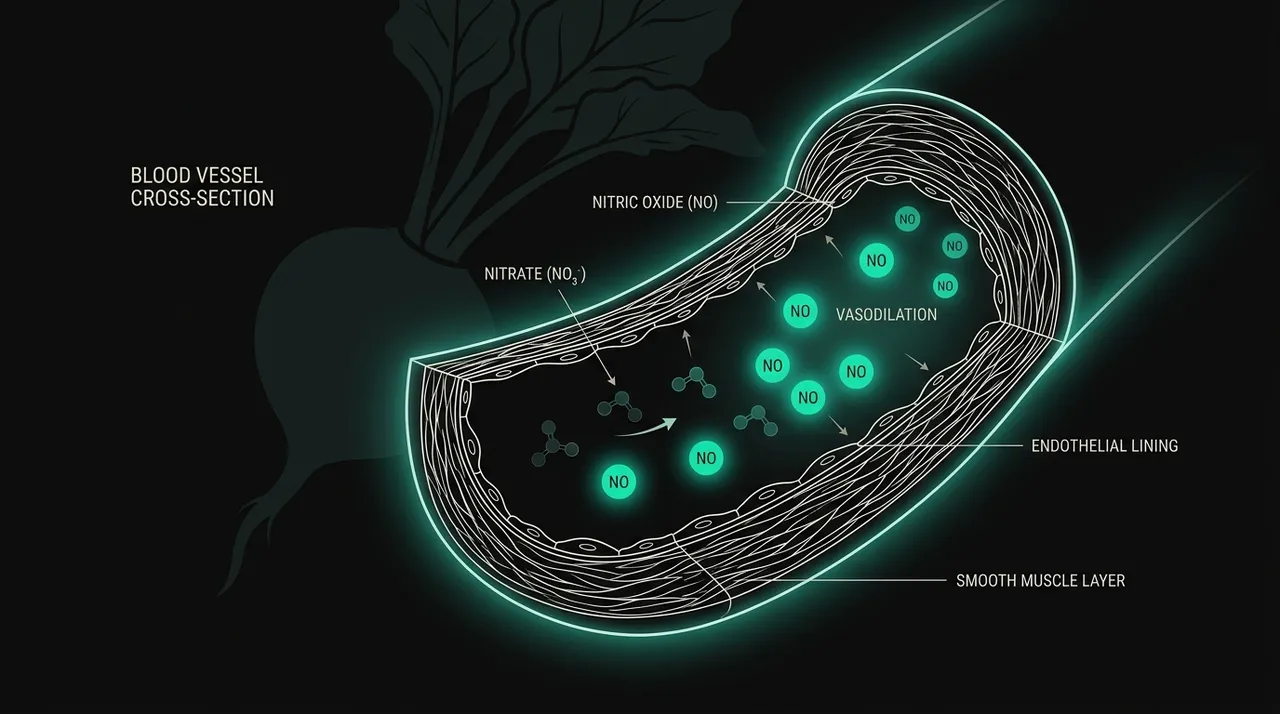
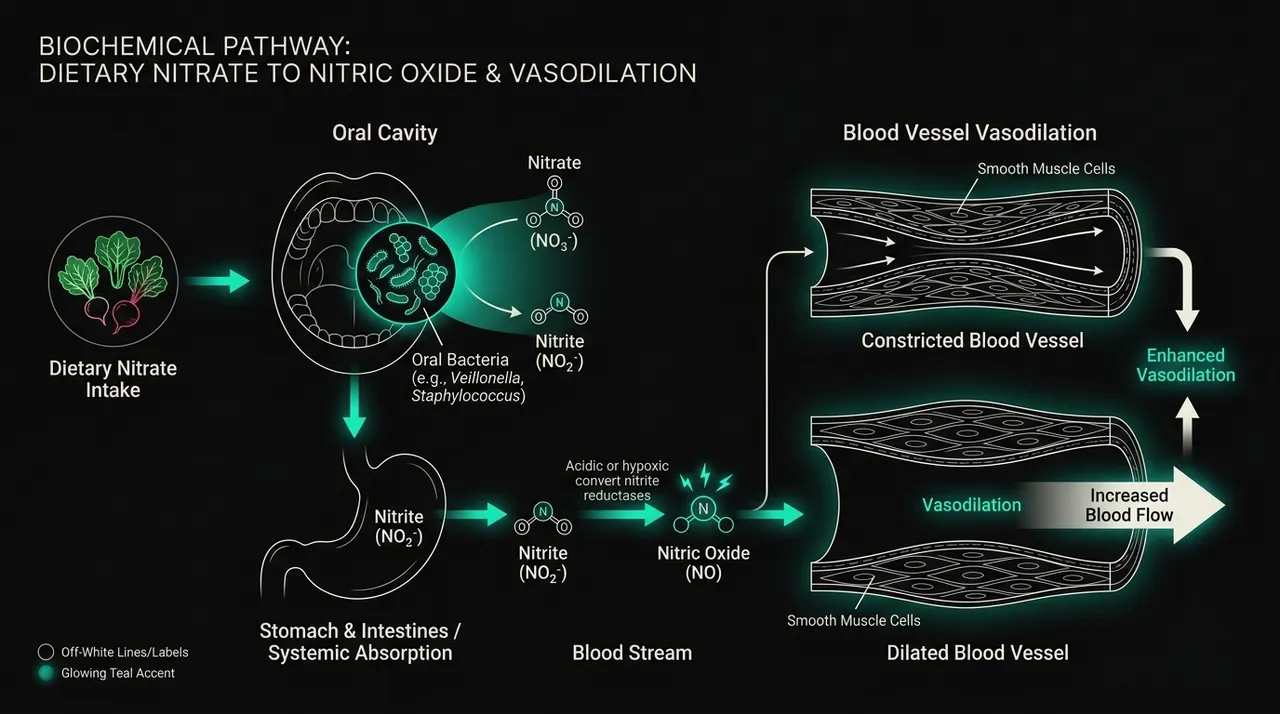
The core mechanism is the nitrate-nitrite-nitric oxide (NO) pathway. Unlike L-citrulline — which works by raising L-arginine availability for nitric oxide synthase [7] — dietary nitrate enters the NO pathway directly: bacteria on the tongue reduce nitrate (NO3-) to nitrite (NO2-), which is further reduced to nitric oxide in the stomach and bloodstream. NO is a potent vasodilator, signaling smooth muscle in vessel walls to relax, lowering systemic resistance and thereby systolic pressure [1][4].
The same pathway may alter mitochondrial efficiency and damp ATP-consuming processes in muscle, reducing the oxygen required for a given output — the mechanism behind the lower steady-state oxygen cost seen in the lab trials [3].
Beetroot juice vs capsules: what the trials actually used
A major consumer confusion is the assumption that all formats perform identically. The trials overwhelmingly used juice or concentrated juice shots, with nitrate-depleted juice as the placebo [2][3]. Dried powders and capsules dominate store shelves, but direct equivalence data between juice and capsules is missing from the trials reviewed here.
The practical translation: the umbrella review's effective subgroup started at 6 mmol/day — about 372 mg of actual nitrate [5]. That is the benchmark a capsule has to hit. Flip a bottle over and look for "nitrate" or "NO3-" with a number in milligrams or mmol, ideally third-party tested. A capsule listing only "beetroot powder 1,000 mg" tells you the weight of dried vegetable, which can carry anywhere from a meaningful dose to nearly none. Until an equivalence trial exists, the stated nitrate yield is the only apples-to-apples number across formats.
| Format | Typical Studied Dose | Duration in Trials | Primary Outcomes | Evidence Notes |
|---|---|---|---|---|
| Concentrated Juice | 140-280 ml (~8.4-16.8 mmol NO3-) [2] | Acute (2.5 h) to 6 days [2][3] | O2 cost reduction, time-to-task failure | Pharmacodynamic dose-response established [2] |
| Juice Beverage | 500 ml (~11.2 mM NO3-) [3] | 6 days | Exercise tolerance; systolic BP fell 124 vs 132 mmHg [3] | Foundational hemodynamic data [3] |
| High-Nitrate Beverage | ~400 mg nitrate [4] | 60 days | 24-h systolic BP -10.8 mmHg [4] | Feasibility trial in hypertensive adults [4] |
| Dried Capsules/Powder | Varies widely | Not established in the trials reviewed | No direct equivalence data | The one evidence gap shoppers most need to know |
Even the juices were not interchangeable — the trials measured and standardized nitrate content precisely because it varies by crop and concentration [2][3]. "Beetroot" on a label is an ingredient name, not a dose.
Practical dosing
Effective dosing tracks the elemental nitrate content, not the gross beetroot weight — the label-reading distinction that matters most. A label might boast "1,000 mg of organic beetroot powder," but if the nitrate yield is negligible, it will not replicate trial outcomes. The trial that moved 24-hour blood pressure used roughly 400 mg/day of nitrate [4], and the umbrella review's subgroup analysis found benefits more pronounced at a minimum of 6 mmol/day (~372 mg nitrate) on protocols longer than 3 days [5]. Look for brands that state nitrate yield (mmol or mg NO3-) from third-party testing rather than total vegetable mass.
Duration expectations: plasma nitrite peaks about 2-3 hours after ingestion [2]. Oxygen-sparing effects are typically measured after 3-6 days of loading [3]; the blood-pressure trial ran 60 days with no sign of tolerance developing [1][4].
Tolerability and interactions:
- Beeturia: pink or red urine and stool after beetroot is common and harmless — it is the query most new users actually have, and the answer is simply that the pigment is passing through.
- Oxalates and kidneys: beets are high in oxalates. People with a history of kidney stones or chronic kidney disease should clear beetroot supplementation with a clinician first.
- Blood-pressure medication: because beetroot can lower systolic pressure [1], combining it with antihypertensives could add to that effect — prescriber should set the plan.
- Pregnancy and breastfeeding: trial data here is essentially absent; standard guidance is to stick to food amounts or check with a clinician.
- Stack tracking: if you mix beetroot with other supplements or prescriptions, check the pairings in the EverPrime app's interaction checker rather than guessing.
What the evidence does NOT show
- It does not show that beetroot treats, cures, or prevents hypertension, heart disease, or any medical condition. These are structure/function findings from small trials, not medical claims.
- It does not show universal performance enhancement. Significant effects cluster in time-to-exhaustion, distance, muscular endurance, and peak power; time-trial performance and several other domains were null, and the underlying reviews rate low to critically low for quality [5].
- It does not show diastolic or 24-hour ambulatory blood-pressure benefit in the pooled analysis [1]. Claiming generic "blood pressure support" without that qualifier misrepresents the data.
- It does not show dried capsules match the trial juices dose-for-dose — no equivalence trials exist in the studies reviewed.
- It does not show any weight-loss or fat-burning effect; no trial reviewed measured it.
Myth-check
Myth: Beetroot is a universally proven endurance booster that makes you faster. Reality: In controlled settings it lowers the oxygen cost of submaximal exercise and extends time-to-task failure [2][3]. The umbrella review of 20 meta-analyses confirms benefits in some task types, null results in others, and the smallest effects in elite athletes [5].
Myth: Beetroot pills are the same as the juice used in trials. Reality: The trials ran on juice and concentrated shots with nitrate-depleted placebo [2][3]. Capsule-to-juice equivalence is unproven; the nitrate yield on the label is the only number that matters.
FAQ
What does a beetroot supplement do?
It provides dietary nitrate, which the body converts to nitric oxide — a pathway associated with mild vasodilation, modest systolic blood-pressure reductions in hypertensive adults, and a lower oxygen cost of some exercise [1][3].
Is it safe to take beetroot pills every day?
Daily use was well tolerated in trials running up to 60 days [1][4]. Expect pink or red urine and stool (beeturia — harmless). People with kidney stones, kidney disease, or on blood-pressure medication should talk to a clinician first.
Is beetroot good for weight loss?
The trials reviewed here did not evaluate beetroot for weight loss or fat reduction. There is no quantitative evidence for that use.
Is beetroot powder as good as beetroot juice?
Most trials used juice or concentrated juice shots, not dried capsule powder [2][3]. Whether a capsule delivers the same nitrate dose as the tested juices is unproven — check the label for stated nitrate content, not total beet weight.
Bottom line
Dietary nitrate from beetroot has real, measurable physiology: modest systolic BP reductions in hypertensive adults [1], a lower oxygen cost of submaximal exercise [2][3], and small but significant endurance-task benefits [5]. It is not a universal performance booster, not a proven capsule product, and not a weight-loss aid. If you use it, buy by stated nitrate content, load for at least 3 days, and expect the biggest effects if you are recreationally active rather than elite. EverPrime tracks nitrate-pathway supplements and their medication interactions in the app; download EverPrime on iOS to check your own stack (Android coming soon).
Related reading
- The NO-pathway sibling: does L-citrulline help with pumps?
- Another circulatory supplement with its own evidence base: nattokinase, a fibrinolytic enzyme also marketed for blood pressure
- Another debated ergogenic aid: does beta-alanine actually work?
- Foundational guides in the supplement science hub
- Form-choice discipline applied to minerals: magnesium glycinate vs citrate
- Recovery-hours supplementation: magnesium for sleep: does it work?
References
- Grönroos R et al. (2024). Effects of beetroot juice on blood pressure in hypertension according to European Society of Hypertension Guidelines: A systematic review and meta-analysis. Nutrition, metabolism, and cardiovascular diseases : NMCD. https://pubmed.ncbi.nlm.nih.gov/39069465/ doi:10.1016/j.numecd.2024.06.009
- Wylie LJ et al. (2013). Beetroot juice and exercise: pharmacodynamic and dose-response relationships. Journal of applied physiology (Bethesda, Md. : 1985). https://pubmed.ncbi.nlm.nih.gov/23640589/ doi:10.1152/japplphysiol.00372.2013
- Bailey SJ et al. (2009). Dietary nitrate supplementation reduces the O2 cost of low-intensity exercise and enhances tolerance to high-intensity exercise in humans. Journal of applied physiology (Bethesda, Md. : 1985). https://pubmed.ncbi.nlm.nih.gov/19661447/ doi:10.1152/japplphysiol.00722.2009
- Siervo M et al. (2020). Nitrate-Rich Beetroot Juice Reduces Blood Pressure in Tanzanian Adults with Elevated Blood Pressure: A Double-Blind Randomized Controlled Feasibility Trial. The Journal of nutrition. https://pubmed.ncbi.nlm.nih.gov/32729923/ doi:10.1093/jn/nxaa170
- Poon ET et al. (2025). Dietary Nitrate Supplementation and Exercise Performance: An Umbrella Review of 20 Published Systematic Reviews with Meta-analyses. Sports medicine (Auckland, N.Z.). https://pubmed.ncbi.nlm.nih.gov/40085422/ doi:10.1007/s40279-025-02194-6
- Abreu R et al. (2023). Effects of dietary supplements on athletic performance in elite soccer players: a systematic review. Journal of the International Society of Sports Nutrition. https://pubmed.ncbi.nlm.nih.gov/37462346/ doi:10.1080/15502783.2023.2236060
- Gonzalez AM et al. (2020). Effects of Citrulline Supplementation on Exercise Performance in Humans: A Review of the Current Literature. Journal of strength and conditioning research. https://pubmed.ncbi.nlm.nih.gov/31977835/ doi:10.1519/JSC.0000000000003426
These statements have not been evaluated by the Food and Drug Administration. This content is for educational purposes only and is not intended as medical advice. It does not diagnose, treat, cure, or prevent any disease. Always consult a qualified healthcare professional before starting any new dietary supplement, especially if you have a medical condition or are taking prescription medications.
Evidence Brief
Get supplement timing and safety notes as they ship.
Monthly evidence briefs. No hype, no disease claims, no influencer supplement stacks.