Ashwagandha vs Magnesium for Stress: The Trial Data
A skeptical breakdown of anxiety and stress relief supplements, contrasting ashwagandha effect sizes with magnesium and B6 vitamin trial data.
The popular belief is that anxiety and stress relief supplements offer a rapid, natural off-switch for modern burnout. The reality from the trials is more interesting—and more honest. Researchers have poured decades into testing compounds like ashwagandha and magnesium. The pooled effect sizes are often statistically significant but burdened by extreme heterogeneity, industry funding, and small samples [1]. The data suggests these compounds may support the stress response, but they are not a cure, and the magnitude of their benefit requires a careful look at the exact metrics.
What the science actually says
When examining the best supplements for stress and anxiety, the evidence pool narrows to a few specific compounds.
Ashwagandha The Arumugam et al. (2024) meta-analysis of nine RCTs (558 patients) reported a significant effect on the Perceived Stress Scale (PSS), the Hamilton Anxiety Scale (HAS), and serum cortisol compared to placebo [4].
Similarly, Akhgarjand et al. (2022) analyzed 12 papers (1,002 participants) and found ashwagandha significantly reduced anxiety (SMD: -1.55) and stress (SMD: -1.75) [1]. However, the certainty of this evidence was rated as low, and the I² statistics were 93.8% for anxiety and 83.1% for stress, meaning the trial results varied wildly [1].
Individual RCTs show the powder reality. Lopresti et al. (2019) gave 60 stressed adults 240 mg of a standardized extract (Shoden) daily for 60 days. They noted a significant reduction in HAM-A scores (p = .040) and morning cortisol (p < .001), but the DASS-21 reduction was only near-significant (p = .096) [3].
Majeed et al. (2023) tested a 500 mg root extract with 5 mg piperine in 54 healthy adults for 60 days. The authors stated PSS, GAD-7, and QOL scores improved "significantly," but the abstract provides no effect sizes—a red flag for overstating impact [2]. This trial was also entirely industry-funded by the extract's manufacturer [2].
Magnesium and Vitamins Noah et al. (2021) evaluated magnesium for anxiety and stress in a post-hoc analysis of adults with low magnesemia and severe stress (DASS-42 >18). The combination of 300 mg magnesium and 30 mg vitamin B6 significantly improved DASS-42 anxiety and depression scores from baseline over 8 weeks, particularly in the first 4 weeks [5]. Pouteau et al. (2018) found this combination superior to magnesium alone for severe stress, establishing a clear baseline-deficiency subgroup [6].
A broader systematic review by McCabe et al. (2017) on women found mixed evidence for essential fatty acids, B vitamins, vitamin C, and zinc on stress levels, marking them as less clinically robust than ashwagandha or magnesium [7].
How HPA-axis modulation may influence stress
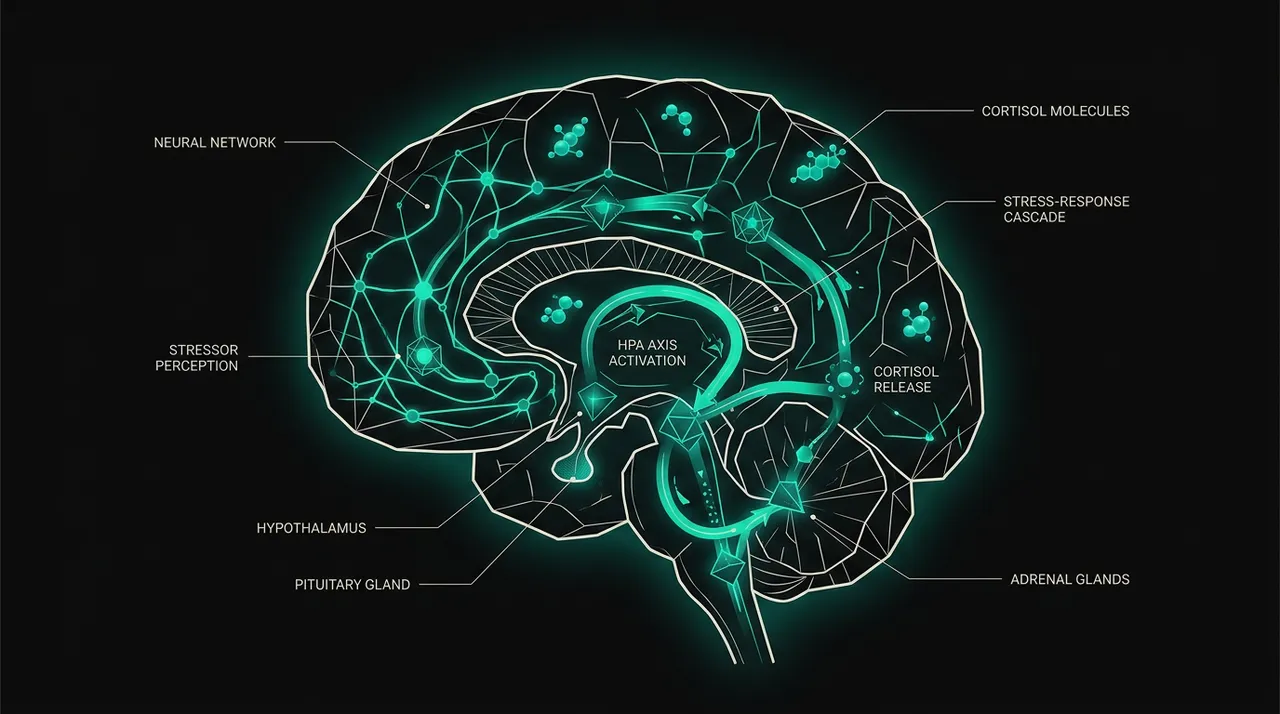
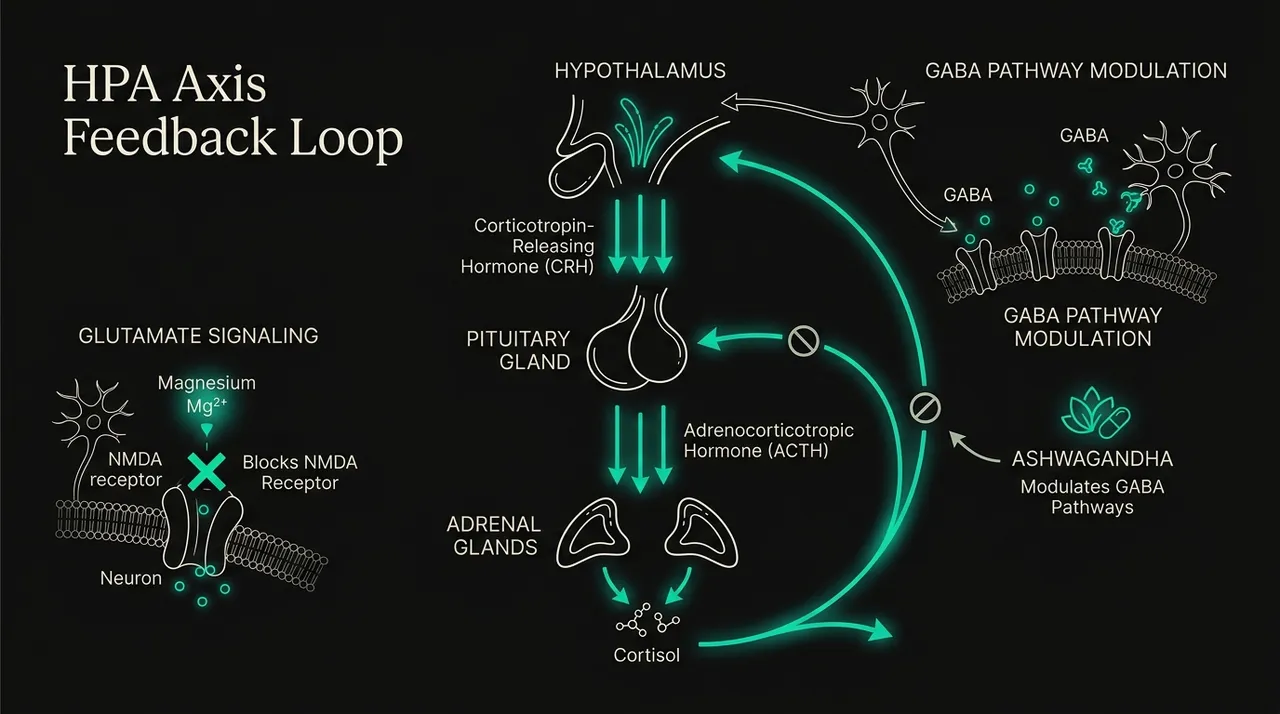
The mechanism of action in these trials appears linked to the hypothalamic-pituitary-adrenal (HPA) axis, the body's central stress response system. When the brain perceives stress, the hypothalamus releases corticotropin-releasing hormone, which signals the pituitary to secrete adrenocorticotropic hormone, which in turn drives cortisol production from the adrenal glands. Chronic activation of this loop can dysregulate feedback inhibition, leading to sustained elevated cortisol and downstream effects on mood, sleep, and cognitive function.
Lopresti et al. (2019) demonstrated that ashwagandha's stress-relieving effects may occur via moderating the HPA axis, noting significant reductions in morning cortisol and DHEA-S compared to placebo [3]. The active withanolide compounds in ashwagandha appear to exert GABA-mimetic activity and may blunt the corticotropin-releasing hormone signal upstream, reducing the amplitude of the stress cascade before it fully activates [3]. Majeed et al. (2023) corroborated the cortisol findings, observing greater reductions in morning salivary cortisol and increases in urinary serotonin [2].
Magnesium operates through a different but complementary pathway. The mineral functions as a natural NMDA receptor antagonist and supports GABA receptor sensitivity, which may help dampen excitatory glutamate signaling in the central nervous system [5]. Low magnesium status is associated with increased neuronal excitability and elevated cortisol secretion under stress, suggesting that repletion may restore normal inhibitory tone rather than produce a pharmacological sedative effect [5]. This mechanistic distinction matters: magnesium appears to correct a deficiency-driven stress vulnerability, whereas ashwagandha may actively modulate the HPA axis even in replete individuals.
Supplement comparison and studied doses
| Supplement | Studied Dose / Duration | Primary Finding | Limitations |
|---|---|---|---|
| Ashwagandha (Shoden) | 240 mg / day for 60 days [3] | HAM-A reduction (p = .040); Cortisol reduction (p < .001) | Small sample (n=60); near-significant DASS-21 (p = .096) [3] |
| Ashwagandha + Piperine | 500 mg root extract / day for 60 days [2] | Improved PSS, GAD-7, QOL (no effect sizes) | Industry-funded; lacks reported effect sizes [2] |
| Magnesium + Vitamin B6 | 300 mg Mg + 30 mg B6 / day for 8 weeks [5] | Improved DASS-42 anxiety/depression in severe stress subgroup | Post-hoc analysis; restricted to low-magnesium, severe-stress adults [5] |
| Magnesium alone | 300 mg Mg / day for 8 weeks [6] | No significant improvement over placebo for severe stress | Less effective than the Mg+B6 combination in the same population [6] |
Practical dosing
When evaluating natural anxiety supplements, label literacy matters. For ashwagandha, the withanolide percentage dictates the active dose, not just the total milligram weight of the root powder. The Lopresti trial used a high-concentration extract standardized to 35% withanolide glycosides [3], while the Majeed trial used a 500 mg root extract with undisclosed withanolide content [2]. This difference in standardization is not trivial: a 240 mg dose of a 35% extract delivers a very different active load than 500 mg of unstandardized root powder. Consumers should verify withanolide content on the label, not just total milligrams.
For magnesium, form choice and GI tolerance matter more than the largest elemental number on the label—a thesis we emphasize across our mineral timing and spacing tools. Magnesium glycinate is often preferred for stress and sleep support because the glycine amino acid may have independent calming properties, and the form is gentle on the gastrointestinal tract. Magnesium citrate absorbs well but can have a laxative effect at higher doses. Magnesium threonate crosses the blood-brain barrier more readily, though direct comparative anxiety trials between forms are limited. Magnesium oxide, common in inexpensive supplements, has poor bioavailability and is generally not ideal for neurological support.
The Noah and Pouteau trials both used 300 mg elemental magnesium combined with 30 mg vitamin B6 daily [5,6]. Notably, Pouteau et al. (2018) found that magnesium alone did not significantly outperform placebo in the same stressed, low-magnesium population, suggesting the B6 co-factor may be mechanistically relevant [6]. Duration expectations should be set at 4 to 8 weeks of consistent daily use before evaluating response; none of the trials reviewed showed benefits within days.
Because the kidneys clear excess magnesium, individuals with kidney disease must exercise caution and consult a clinician before supplementing. You can verify mineral-antibiotic timing using our dedicated tool.
Safety and tolerability
Both compounds carry tolerability considerations that the trial abstracts do not fully detail. Ashwagandha may increase thyroid hormone levels and should be avoided or monitored in individuals with hyperthyroidism or those taking thyroid medication. Traditional use contraindications include pregnancy and autoimmune conditions, though the RCTs reviewed here excluded these populations, so safety data in those groups is not available from the trial literature.
Magnesium at the 300 mg elemental dose used in the trials is generally well-tolerated, though some individuals experience loose stools, particularly with citrate or oxide forms. The glycinate form typically produces fewer GI symptoms. Magnesium can interact with certain antibiotics (tetracyclines, fluoroquinolones), bisphosphonates, and diuretics, so spacing doses away from these medications is standard guidance. Neither compound should replace consultation with a qualified healthcare provider, particularly for individuals with diagnosed anxiety disorders, as the trial evidence does not establish equivalence to standard care.
What the evidence does NOT show
- It does not show these compounds treat, cure, or prevent clinical disease. These are structure/function findings that may support daily well-being, not medical interventions for diagnosable psychiatric disorders.
- It does not show "fast" acute relief. The data covers cumulative effects over 4 to 8 weeks. None of these vitamins for anxiety and stress function as a rapid rescue medication.
- It does not show all adaptogens are interchangeable. The specific extracts standardized for withanolides (like Shoden) have specific data [3]. Broad, unstandardized powders lack quantitative backing.
- It does not show clear superiority over standard care. These trials measure isolated supplementation. The evidence does not compare these compounds against established first-line therapies.
Myth-check
Myth: Ashwagandha is the strongest natural anxiety medication. Reality: While the best herbs for stress and anxiety pool includes ashwagandha, calling it a "medication" misrepresents the data. Its effect sizes (SMD: -1.55) come with a 93.8% heterogeneity rate, and the authors explicitly rated the certainty of the evidence as "low" [1].
FAQ
Is magnesium or ashwagandha better for anxiety?
Ashwagandha demonstrates larger pooled effect sizes in stress and anxiety metrics, but with significant heterogeneity in the research [1]. Magnesium with vitamin B6 may support stress reduction, but the evidence is more modest and heavily dependent on baseline characteristics [5].
Can vitamins for anxiety and stress work immediately?
No. The trials reviewed here show that benefits are observed over 4 to 8 weeks of consistent daily use, not as an acute rescue intervention [2,5].
What is the most actionable dosing subgroup for stress supplements?
Adults with low baseline magnesium and severe stress (DASS-42 stress subscale >18) showed the most notable symptom improvement when taking a combination of 300 mg magnesium and 30 mg vitamin B6 [5].
Related reading
- Ashwagandha Supplement Guide
- Magnesium Supplement Overview
- Stress Resilience Condition Hub
- Magnesium for Sleep: Does It Work?
- Magnesium Glycinate vs Citrate
- Magnesium and Calcium Supplement Interaction
References
- Akhgarjand C et al. (2022). Does Ashwagandha supplementation have a beneficial effect on the management of anxiety and stress? A systematic review and meta-analysis of randomized controlled trials. Phytotherapy research : PTR. https://pubmed.ncbi.nlm.nih.gov/36017529/ doi:10.1002/ptr.7598
- Majeed M et al. (2023). A standardized Ashwagandha root extract alleviates stress, anxiety, and improves quality of life in healthy adults by modulating stress hormones: Results from a randomized, double-blind, placebo-controlled study. Medicine. https://pubmed.ncbi.nlm.nih.gov/37832082/ doi:10.1097/MD.0000000000035521
- Lopresti AL et al. (2019). An investigation into the stress-relieving and pharmacological actions of an ashwagandha (Withania somnifera) extract: A randomized, double-blind, placebo-controlled study. Medicine. https://pubmed.ncbi.nlm.nih.gov/31517876/ doi:10.1097/MD.0000000000017186
- Arumugam V et al. (2024). Effects of Ashwagandha (Withania Somnifera) on stress and anxiety: A systematic review and meta-analysis. Explore (New York, N.Y.). https://pubmed.ncbi.nlm.nih.gov/39348746/ doi:10.1016/j.explore.2024.103062
- Noah L et al. (2021). Effect of magnesium and vitamin B6 supplementation on mental health and quality of life in stressed healthy adults: Post-hoc analysis of a randomised controlled trial. Stress and health : journal of the International Society for the Investigation of Stress. https://pubmed.ncbi.nlm.nih.gov/33864354/ doi:10.1002/smi.3051
- Pouteau E et al. (2018). Superiority of magnesium and vitamin B6 over magnesium alone on severe stress in healthy adults with low magnesemia: A randomized, single-blind clinical trial. PloS one. https://pubmed.ncbi.nlm.nih.gov/30562392/ doi:10.1371/journal.pone.0208454
- McCabe D et al. (2017). The impact of essential fatty acid, B vitamins, vitamin C, magnesium and zinc supplementation on stress levels in women: A systematic review. JBI database of systematic reviews and implementation reports. https://pubmed.ncbi.nlm.nih.gov/28178022/ doi:10.11124/JBISRIR-2016-002965
Statements have not been evaluated by the Food and Drug Administration. This content is for educational purposes only and is not a substitute for professional medical advice. It is not intended to diagnose, treat, cure, or prevent any disease. Always consult your healthcare provider before starting a new supplement regimen, especially if you have existing health conditions or take prescription medications.
Evidence Brief
Get supplement timing and safety notes as they ship.
Monthly evidence briefs. No hype, no disease claims, no influencer supplement stacks.