Magnesium glycinate vs citrate vs oxide: the form actually matters
Magnesium labels hide a practical problem: the compound attached to magnesium changes dose size, tolerance, and how confidently you can use the product.
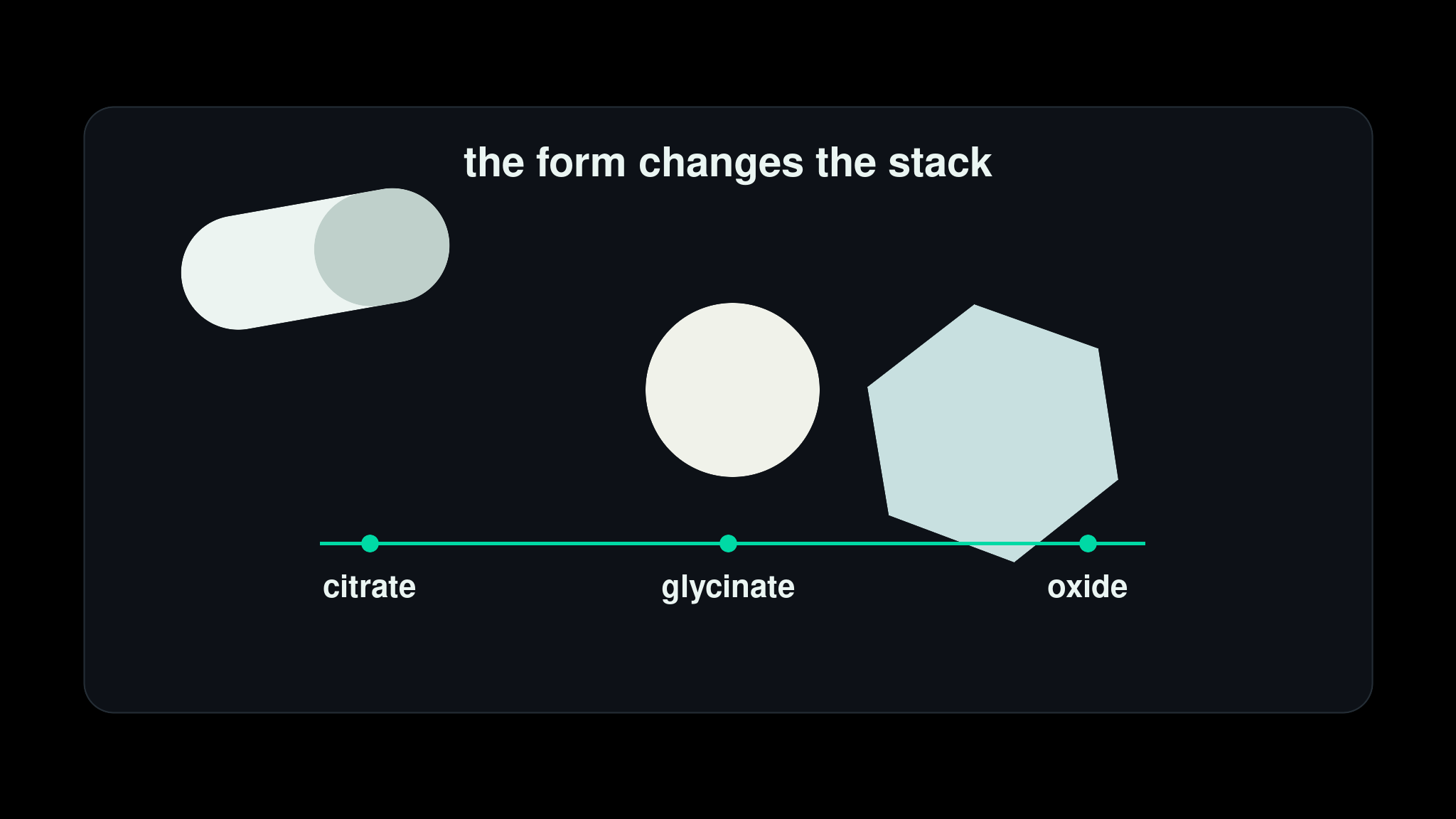
Fast answer: do not pick magnesium by milligrams alone. Pick the form for the job: citrate when you want a well-studied, practical default; glycinate when tolerance and an evening slot matter; oxide only when cost, elemental dose, or a specific use case is more important than absorption confidence.
Magnesium is one of the most common supplement-stack ingredients, but most labels make it hard to answer the only question that matters: what are you actually getting?
The front of the bottle may say "400 mg magnesium." The Supplement Facts panel may say "magnesium oxide," "magnesium citrate," "magnesium glycinate," or a proprietary blend that hides the exact mix. Those forms are not interchangeable. They differ in elemental magnesium, solubility, gut tolerance, pill size, and the strength of the human evidence behind them.
That is why the better question is not "which magnesium is best?" It is:
Which magnesium form matches the job I am asking it to do?
The form changes the decision
Magnesium is an element. Supplements do not usually deliver it as pure magnesium metal. They bind magnesium to another compound so it can be manufactured, swallowed, and absorbed. That partner compound is the form.
The form affects four practical variables:
Form matrix
Magnesium form changes the tradeoff
| Variable | Why it matters |
|---|---|
| Elemental magnesium | How much actual magnesium is in the serving |
| Solubility and absorption | How much of the dose is likely to become usable |
| GI tolerance | Whether the dose causes loose stool, cramping, or nausea |
| Pill burden | How many capsules are needed for a meaningful dose |
Magnesium oxide has a high elemental magnesium percentage, so the pill can look potent. But human bioavailability studies have repeatedly suggested that oxide performs worse than several organic forms. Firoz and Graber concluded that magnesium oxide had relatively poor bioavailability compared with magnesium chloride, lactate, and aspartate (PMID 11794633). A later randomized crossover study also found higher bioavailability for magnesium citrate than magnesium oxide using urinary excretion and serum measures (PMID 32162607).
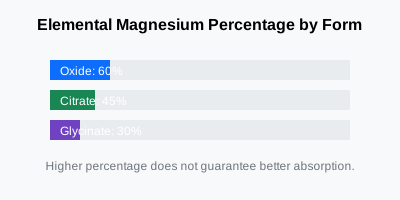
That does not make oxide fake. It means the label dose is not the whole dose.
The EverPrime rule: elemental magnesium tells you what is in the capsule. Form quality and tolerance tell you whether that capsule fits the stack.
Magnesium citrate: the practical default
Magnesium citrate is often the cleanest default for people who want a form with better evidence than oxide and a reasonable price. It is an organic magnesium salt, generally more soluble than oxide, and has direct human comparison data against oxide.
The tradeoff is tolerance. Citrate can loosen stools, especially at higher supplemental doses or when taken all at once. That can be useful for some people in clinician-directed contexts, but it is not ideal if the goal is a calm daily repletion dose.
Use citrate when:
- You want a cost-effective form with better absorption confidence than oxide.
- You tolerate it well.
- You are building a daytime or meal-adjacent magnesium slot.
- You want a simple default before paying more for specialty forms.
Be more cautious when:
- You already have loose stools or irritable gut patterns.
- You are stacking citrate with other bowel-active ingredients.
- You are taking high doses without tracking total supplemental magnesium.
Magnesium glycinate: tolerance first, evidence second
Magnesium glycinate, often sold as magnesium bisglycinate, binds magnesium to glycine. In the market, it is positioned as the "sleep" or "calm" magnesium. That positioning is partly plausible, but it is often stronger than the evidence.
Glycine itself has research interest in sleep and thermoregulation, and a recent randomized placebo-controlled trial studied magnesium bisglycinate in healthy adults reporting poor sleep (PMC12412596). But supplement shoppers should separate two claims:
- Glycinate may be easier to tolerate for many users.
- Glycinate is not automatically proven superior for every magnesium goal.
The practical case for glycinate is usually tolerance, not magic. If citrate bothers your gut, if oxide feels unreliable, or if your magnesium slot is at night and you want fewer GI surprises, glycinate is a sensible candidate.
Use glycinate when:
- You want a gentler evening form.
- Citrate causes loose stool.
- You are taking magnesium consistently and adherence matters.
- You are willing to pay more per effective serving.
Be more cautious when:
- A product hides the amount of elemental magnesium.
- The serving size requires many capsules.
- The marketing claims sleep benefits without citing human trials.
Magnesium oxide: high label dose, lower absorption confidence
Magnesium oxide is common because it is cheap, compact, and high in elemental magnesium. A 400 mg magnesium oxide label can look stronger than a 120 mg magnesium glycinate label. But the high elemental percentage can mislead users into thinking they are getting a more effective product.
Human evidence suggests oxide has poorer bioavailability than several alternatives (PMID 11794633). The 2019 crossover study comparing citrate and oxide also supports citrate as the stronger absorption pick (PMID 32162607).
Oxide is not automatically wrong. It may be reasonable when cost is the binding constraint, when the use case is specific, or when a clinician chose it for a reason. But for a supplement optimizer choosing from scratch, oxide is usually not the premium default.
Use oxide when:
- Cost is the main constraint.
- You understand that elemental dose does not equal absorbed dose.
- A clinician or pharmacist recommended it for a specific context.
Avoid making oxide your default when:
- You are trying to correct a low-magnesium pattern.
- You already tried it and noticed no benefit or poor tolerance.
- The label uses oxide to advertise a large number without context.
The label audit: five checks before you buy
Before buying magnesium, check the Supplement Facts panel, not just the front label.
Label scan
What a strong supplement label makes easy to verify
Exact form
Compound is named, not hidden behind the nutrient.
Dose per serving
Real daily dose is clear after serving math.
Quality signal
Testing mark, lot path, or certificate exists.
Timing risk
Minerals, caffeine, meals, and medication windows are visible.
| Check | What to look for | Why it matters |
|---|---|---|
| Form | Citrate, glycinate, oxide, chloride, malate, threonate, blend | The form drives tolerance and absorption confidence |
| Elemental amount | The actual magnesium per serving | Some labels list compound weight instead of elemental magnesium |
| Serving size | Capsules per dose | A clean formula may still be impractical if it requires four capsules |
| Other minerals | Calcium, zinc, iron, multivitamin blend | Minerals can compete or complicate timing |
| Add-ons | Melatonin, herbs, laxatives | Add-ons change the risk profile and make attribution harder |
This is where many "sleep magnesium" products fail the test. They combine magnesium with melatonin, GABA, ashwagandha, L-theanine, or herbs. That may be appropriate for some people, but it makes it harder to know whether magnesium is doing anything. For a clean experiment, single-ingredient magnesium is easier to evaluate.
If you are testing a new form, change only one thing: the form, the dose, or the timing. Changing all three makes the result impossible to interpret.
Timing and interactions still matter
The best magnesium form can still fail if the timing is wrong.
Magnesium can bind certain antibiotics in the gut and reduce absorption. That is why EverPrime uses a conservative spacing rule for tetracycline and fluoroquinolone antibiotics: keep magnesium, calcium, iron, zinc, and mineral-heavy multivitamins away from the medication window unless a clinician gives different instructions. See the full mineral timing guide: mineral-antibiotic timing.
Magnesium can also compete for attention inside a crowded supplement stack. If your morning slot includes magnesium, zinc, calcium, a multivitamin, coffee, and an iron supplement, the issue is not only which magnesium form you chose. The issue is that the slot is overloaded. For iron specifically, see calcium and iron timing.
For vitamin D, magnesium is often discussed because magnesium participates in vitamin D metabolism. That does not mean everyone needs to take both together, but it does mean the broader stack should be designed intentionally. See vitamin D with food timing.
A simple decision tree
Use this as a practical starting point:
| Situation | Best first pick | Why |
|---|---|---|
| You want a default daily magnesium | Citrate | Better evidence than oxide, usually accessible |
| Citrate bothers your gut | Glycinate | Often chosen for tolerance |
| You want an evening slot | Glycinate | Less likely to disrupt adherence if tolerated |
| You are cost-constrained | Citrate or oxide | Citrate if possible; oxide if budget dominates |
| You are on interacting medications | Ask pharmacist first | Timing matters more than form |
| You have kidney disease | Clinician-guided only | Magnesium handling can be unsafe when renal function is impaired |
The adult tolerable upper intake level for supplemental magnesium is 350 mg/day according to the NIH Office of Dietary Supplements; this does not include magnesium from food (NIH ODS). The limit is based largely on diarrhea risk, but high intake can be more serious in people with impaired kidney function or medication interactions.
The EverPrime stack rule
Do not buy the biggest magnesium number. Buy the cleanest match for your goal.
- If you want absorption confidence at a reasonable cost, start with citrate.
- If tolerance is the constraint, test glycinate.
- If the label relies on oxide, understand the tradeoff before assuming the dose is stronger.
- Keep magnesium away from interacting medication windows.
- Track response, side effects, timing, and total supplemental magnesium.
The best magnesium product is not the one with the loudest label. It is the one you can place correctly, tolerate consistently, and justify from the evidence.
EverPrime is built for this exact problem: translating supplement labels into form, dose, timing, quality, and interaction decisions. Download EverPrime on iOS to audit your magnesium slot against the rest of your stack.
Sources
- Firoz M, Graber M. Bioavailability of US commercial magnesium preparations. PMID 11794633
- Schuchardt JP, Hahn A. Intestinal absorption and factors influencing bioavailability of magnesium. PMID 27624531
- Kappeler D, et al. Higher bioavailability of magnesium citrate as compared to magnesium oxide shown by evaluation of urinary excretion and serum levels after single-dose administration in a randomized cross-over study. PMID 32162607
- Office of Dietary Supplements, National Institutes of Health. Magnesium fact sheet for health professionals. NIH ODS
- Magnesium Bisglycinate Supplementation in Healthy Adults Reporting Poor Sleep: A Randomized, Placebo-Controlled Trial. PMC12412596
Pending medical review. We are partnering with board-certified clinicians to formalize this credit — see /about/medical-review for status.
These statements have not been evaluated by the FDA. Not intended to diagnose, treat, cure, or prevent any disease.
Generated with AI assistance. Always verify with a healthcare professional.
Educational information only. Not a substitute for professional medical advice.
Evidence Brief
Get supplement timing and safety notes as they ship.
Monthly evidence briefs. No hype, no disease claims, no influencer supplement stacks.