Magnesium and Calcium Supplements: The Honest Trial Data
A trial-level look at magnesium and calcium supplement benefits. Evidence supports specific structure-function roles, but popular claims for cramps and sarcopenia fall flat.

Walk down any supplement aisle, and the messaging is unavoidable: a calcium magnesium supplement is the ultimate dual-action pill for calming your nerves, stopping nighttime muscle cramps, and fortifying your skeleton. The popular belief is that these two minerals are a magical, synergistic pair that absolutely must be taken together to work. The reality from the trials is more interesting, and frankly, more honest. When you look past the marketing at the actual trial data, the human evidence for broad, sweeping benefits—like banishing nocturnal leg cramps or reversing age-related muscle loss—is overwhelmingly null or frustratingly inconsistent. In contrast, the well-supported benefits are highly specific, structural, and entirely dependent on getting the form, the dose, and the timing right.
What the science actually says
When researchers actually test these minerals in rigorous human trials, the results frequently clash with wellness marketing. The Cochrane review by Garrison et al. (2020) aimed to assess the effects of magnesium supplementation compared to placebo for skeletal muscle cramps [1]. Enrolling 735 individuals across 11 trials, the review found that for idiopathic cramps (largely in older adults), the differences in cramp frequency were small and not statistically significant. Specifically, the mean difference in the percentage change from baseline in the number of cramps per week at four weeks was -9.59% (95% CI -23.14% to 3.97%). The percentage of individuals experiencing a 25% or better reduction in cramp rate from baseline was also no different (RR 1.04, 95% CI 0.84 to 1.29). They concluded it is unlikely that magnesium provides clinically meaningful cramp prophylaxis to older adults.
When looking at muscle strength, van Dronkelaar et al. (2018) evaluated the role of minerals, including magnesium and calcium, on muscle mass and physical performance in older adults [3]. The broad systematic review highlighted the complexity of relying on mineral supplementation for age-related physical decline, noting a lack of conclusive, high-impact data for isolated mineral dosing in preventing sarcopenia.
For calcium specifically, the Women's Health Initiative randomized 36,282 postmenopausal women to 1,000 mg elemental calcium carbonate plus 400 IU vitamin D3 daily versus placebo [4]. After an average of seven years, hip bone mineral density was modestly preserved (approximately 1% higher than placebo), but the reduction in hip fracture risk did not reach statistical significance for the full cohort. The signal emerged primarily in women who were adherent to supplementation, suggesting that consistent, long-term intake matters more than sporadic dosing. This pattern—modest structural support, not dramatic fracture prevention—is representative of calcium trial data in generally healthy adults.
There is veterinary data suggesting broader systemic mineral interactions. A randomized trial in cats with chronic kidney disease found that magnesium-supplemented diets stabilized fibroblast growth factor-23 concentration compared to controls [2] (animal data — hypothesis, not proof). Human validation is required.
How magnesium and calcium may influence vascular function
Mechanistically, these minerals interact with fundamental physiological pathways. Magnesium is heavily associated with vascular smooth muscle relaxation and normal endothelial function, serving as a natural calcium channel antagonist at the intracellular level [5]. Conversely, calcium is integral to normal smooth muscle and cardiac contraction [6].
Disruptions in systemic calcium availability are well-documented in clinical literature. For instance, the presence of vascular and soft tissue calcification represents a primary safety concern when evaluating isolated calcium supplementation. Curtis et al. (2021) systematically evaluated the cardiovascular safety of minerals like calcium and magnesium [6]. The review pointed out the nuanced, sometimes paradoxical, relationship between isolated calcium supplementation and overall cardiovascular safety markers, emphasizing that total dietary context matters and that exceeding physiological requirements does not linearly translate to enhanced structural support. Tangvoraphonkchai et al. (2018) outlined the association between maintaining adequate magnesium status and overall cardiovascular health biomarkers [5].
Comparison of Supplement Forms
Choosing a mineral where form choice, GI tolerance, and medication spacing matter more than the biggest elemental number is the core thesis of EverPrime's approach to supplementation. Different forms dictate not only absorption rates but also gastrointestinal side effects, which were notably highlighted in the Cochrane review where oral magnesium was associated with minor gastrointestinal adverse events like diarrhea [1].
| Supplement Context | Primary Use Case | Evidentiary / Safety Notes |
|---|---|---|
| Magnesium (Citrate) | General dietary support; vascular relaxation | Garrison et al. found no meaningful cramp reduction (MD -9.59%, 95% CI -23.14% to 3.97%) [1]. Loose stools are common at higher doses. |
| Magnesium (Glycinate) | Tolerance-first supplementation | Lower elemental density per pill, but preferred for gastrointestinal comfort. No cramp-specific trial data. |
| Calcium (Carbonate/Citrate) | Structural support; bone density | WHI: ~1% better hip BMD with 1,000 mg/day + D, but no significant fracture reduction in full cohort [4]. Requires medication spacing [6]. |
| Combination Pills | Convenience | Often forces suboptimal dosing. The 2:1 calcium-to-magnesium ratio is a manufacturing convention, not a proven synergistic optimum. |
| Zinc Added (Calcium Magnesium Zinc) | Multi-mineral formulas | Quantitative outcome data for the specific triad is absent from rigorous RCTs. |
Practical dosing
When considering a calcium magnesium supplement, label literacy is essential. Consumers frequently confuse total compound weight with elemental yield. For example, 1,000 mg of calcium carbonate yields approximately 400 mg of elemental calcium. You must look for the "elemental" designation on the Supplement Facts panel to understand your actual intake.
According to the National Institutes of Health Office of Dietary Supplements (NIH ODS), the Recommended Dietary Allowance (RDA) for most adults ranges from 310 to 420 mg of elemental magnesium and 1,000 to 1,200 mg of elemental calcium daily.
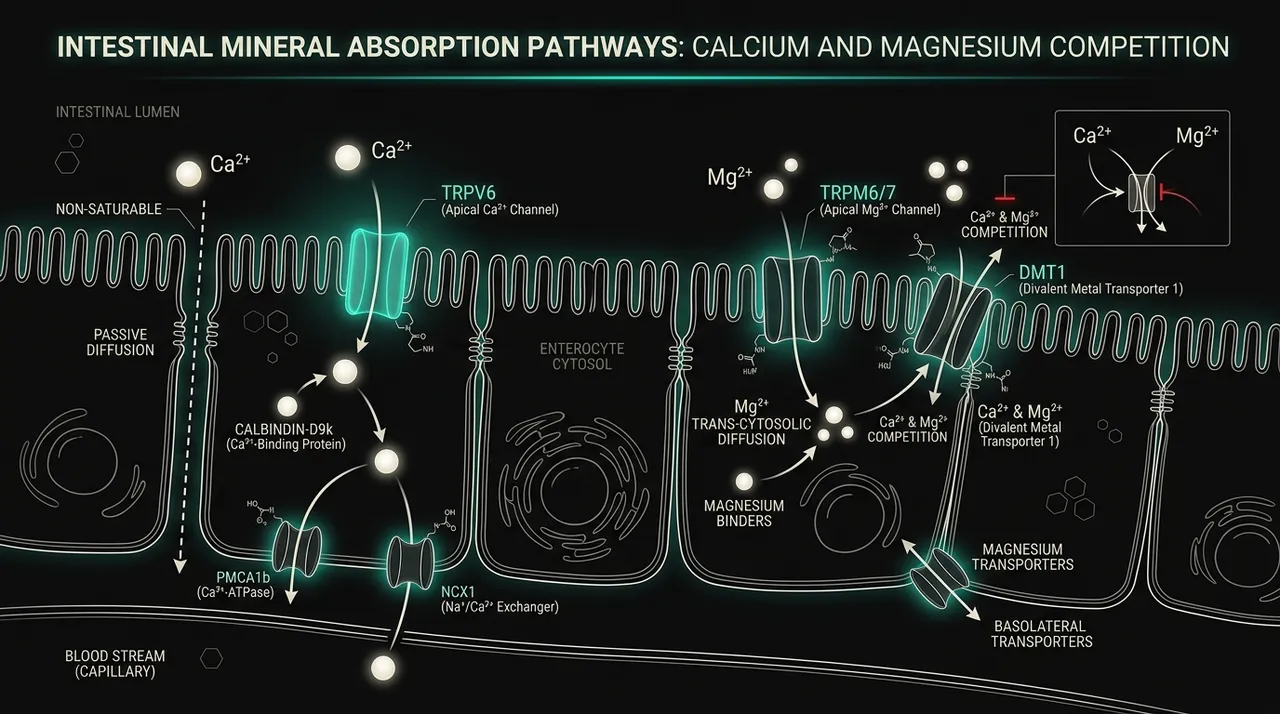
Timing is highly relevant. While taking calcium and magnesium at night is a popular wellness trend for relaxation, isolating these minerals often makes more physiological sense. Calcium and magnesium share intestinal absorption pathways. At high single doses, they can compete for transport, which is why spacing doses by several hours often improves uptake of both. Standard guidance is to separate calcium doses from certain medications. Calcium is well-documented to chelate with tetracycline and fluoroquinolone antibiotics, as well as bisphosphonates and thyroid medications, drastically reducing drug bioavailability.
If you are currently managing cardiovascular conditions or kidney disease, high elemental mineral doses require strict clinician guidance. The kidneys are primarily responsible for mineral excretion, and impaired renal clearance can lead to dangerous systemic accumulation.
Consumers frequently worry about side effects like nausea or mild constipation from calcium, or diarrhea from highly bioavailable forms of magnesium like citrate. These effects are usually mild and self-limiting. Concerns about kidney oxalate management are also common. While citrate forms of minerals may interact with metabolic pathways, using supplements as a primary strategy for kidney health should only be done under medical supervision. Sharbaugh et al. (2025) conducted a randomized controlled trial evaluating the timing of magnesium supplementation in patients with nephrolithiasis [2], demonstrating that precise metabolic interventions require clinical oversight rather than self-experimentation.
What the evidence does NOT show
- It does not show that a magnesium and calcium supplement treats, cures, or prevents any disease. These are strictly structure/function findings related to baseline nutritional adequacy.
- It does not show that combining the minerals unlocks a unique synergy. The trials reviewed here do not support the popular claim that taking calcium and magnesium in a single pill provides superior biological benefits compared to dosing them separately based on individual tolerability.
- It does not show that this combination reverses sarcopenia. Despite heavy marketing toward older adults, the systematic review by van Dronkelaar et al. failed to provide conclusive evidence that isolated mineral supplementation improves muscle mass or physical performance in older adults [3].
- It does not show that magnesium is an effective standalone intervention for idiopathic muscle cramps. High-certainty data demonstrates no statistically significant difference over placebo [1].
Myth-check
The popular claim: Taking a magnesium and calcium supplement at night will stop your muscle cramps, lower your blood pressure, and act as a natural sedative due to the synergistic calming effects of the minerals.
The reality: This is an aggregation of unsupported marketing claims. Moderate to high-certainty evidence shows magnesium is unlikely to provide clinically meaningful cramp prophylaxis for older adults [1]. Isolated supplement pills without broader dietary context show negligible impact on blood pressure or sleep quality.
FAQ
Is taking a magnesium and calcium supplement together the best approach?
Combination dosing requires careful attention to total elemental amounts and medication spacing. Separating doses by a few hours often helps optimize absorption and minimize gastrointestinal side effects. [1]
Does a magnesium and calcium supplement help with nighttime muscle cramps?
Moderate to high-certainty evidence indicates magnesium is unlikely to provide clinically meaningful cramp prophylaxis for older adults experiencing idiopathic skeletal muscle cramps. [1]
Are there specific cardiovascular structure-function benefits associated with these minerals?
Magnesium is associated with vascular relaxation, while calcium is integral to muscle contraction. However, the specific safety and cardiovascular outcomes of isolated supplementation require individualized assessment. [5] [6]
Related reading
- Magnesium Supplements: An Evidence-Based Overview
- Calcium Supplements and Bioavailability
- Understanding Supplement Science
- Magnesium for Sleep: Does It Work?
- Magnesium Glycinate vs Citrate
- Bone Health and Mineral Foundations
References
- Garrison SR, Korownyk CS, Kolber MR, et al. (2020). Magnesium for skeletal muscle cramps. The Cochrane database of systematic reviews. https://pubmed.ncbi.nlm.nih.gov/32956536/ doi:10.1002/14651858.CD009402.pub3
- Tang PK, van den Broek DHN, Jepson RE, et al. (2024). Dietary magnesium supplementation in cats with chronic kidney disease: A prospective double-blind randomized controlled trial. Journal of veterinary internal medicine. https://pubmed.ncbi.nlm.nih.gov/38952053/ doi:10.1111/jvim.17134
- van Dronkelaar C, van Velzen A, Abdelrazek M, et al. (2018). Minerals and Sarcopenia; The Role of Calcium, Iron, Magnesium, Phosphorus, Potassium, Selenium, Sodium, and Zinc on Muscle Mass, Muscle Strength, and Physical Performance in Older Adults: A Systematic Review. Journal of the American Medical Directors Association. https://pubmed.ncbi.nlm.nih.gov/28711425/ doi:10.1016/j.jamda.2017.05.026
- Jackson RD, LaCroix AZ, Gass M, et al. (2006). Calcium plus vitamin D supplementation and the risk of fractures. New England journal of medicine. https://pubmed.ncbi.nlm.nih.gov/16481635/ doi:10.1056/NEJMoa055218
- Tangvoraphonkchai K, et al. (2018). Magnesium and Cardiovascular Disease. Advances in chronic kidney disease. https://pubmed.ncbi.nlm.nih.gov/29793664/ doi:10.1053/j.ackd.2018.02.010
- Curtis EM, et al. (2021). Cardiovascular safety of calcium, magnesium and strontium: what does the evidence say?. Aging clinical and experimental research. https://pubmed.ncbi.nlm.nih.gov/33565045/ doi:10.1007/s40520-021-01799-x
These statements have not been evaluated by the Food and Drug Administration. This content is for educational purposes only and is not intended to diagnose, treat, cure, or prevent any disease. It is not a substitute for professional medical advice. Always consult your physician or qualified healthcare provider before starting any new dietary supplement, especially if you have a medical condition or are taking prescription medications.
Stop guessing with medication timing. EverPrime tracks 41 documented supplement-medication interactions to keep you safe. Check your stack with our interaction engine today.
Evidence Brief
Get supplement timing and safety notes as they ship.
Monthly evidence briefs. No hype, no disease claims, no influencer supplement stacks.