Signs of Magnesium Deficiency: What the Evidence Says
What are the real signs of magnesium deficiency? An evidence-based look at symptoms, causes, who's at risk, and what supplementation can and can't do.

Muscle cramps, fatigue, a vague sense of being wired-but-tired—these get blamed on low magnesium constantly. The honest answer is messier: the classic signs of magnesium deficiency are real, but they're also nonspecific, and you can't diagnose yourself from a twitchy eyelid. Here's what the evidence actually supports, and where the popular story falls apart.
Why magnesium matters in the first place
Magnesium is a cofactor in hundreds of reactions tied to energy metabolism, glucose regulation, cardiovascular function, bone integrity, and nerve signaling [4]. When intake is chronically low, those systems are the first to show strain—which is why deficiency symptoms tend to be broad rather than pinpointed.
And low intake is genuinely common. A 2025 review estimated that roughly 2.4 billion people, about 31% of the global population, fail to meet recommended magnesium intake levels [4]. Modeling work in Lancet Global Health found that, within the same countries and age groups, estimated inadequate intakes were higher for men than for women for magnesium [3]. This isn't a fringe nutrient gap.
The actual signs of magnesium deficiency
Clinically, magnesium depletion shows up in stages. Mild-to-moderate cases are easy to miss; the symptoms overlap with stress, poor sleep, and dozens of other things.
| Symptom pattern | Associated with low magnesium? | Important caveat |
|---|---|---|
| Muscle cramps, spasms, twitches | Commonly reported [6] | Also caused by dehydration, overuse, other electrolytes |
| Fatigue, low energy | Plausible via energy metabolism role [4] | Extremely nonspecific |
| Irritability, low mood | Linked to neuropsychiatric effects [4] | Many other causes |
| Abnormal heart rhythm | Seen in severe depletion [6][8] | A medical issue—needs evaluation, not self-treatment |
| Low potassium / low calcium that won't correct | Classic clue clinicians look for [6][8] | Requires lab testing |
A key point from the clinical literature: magnesium deficiency rarely travels alone. It frequently drags down potassium and calcium, and those secondary disturbances often produce the more dramatic symptoms [6][8]. That's also why some people's low potassium simply won't correct until magnesium is restored.
How it works—and why blood tests mislead
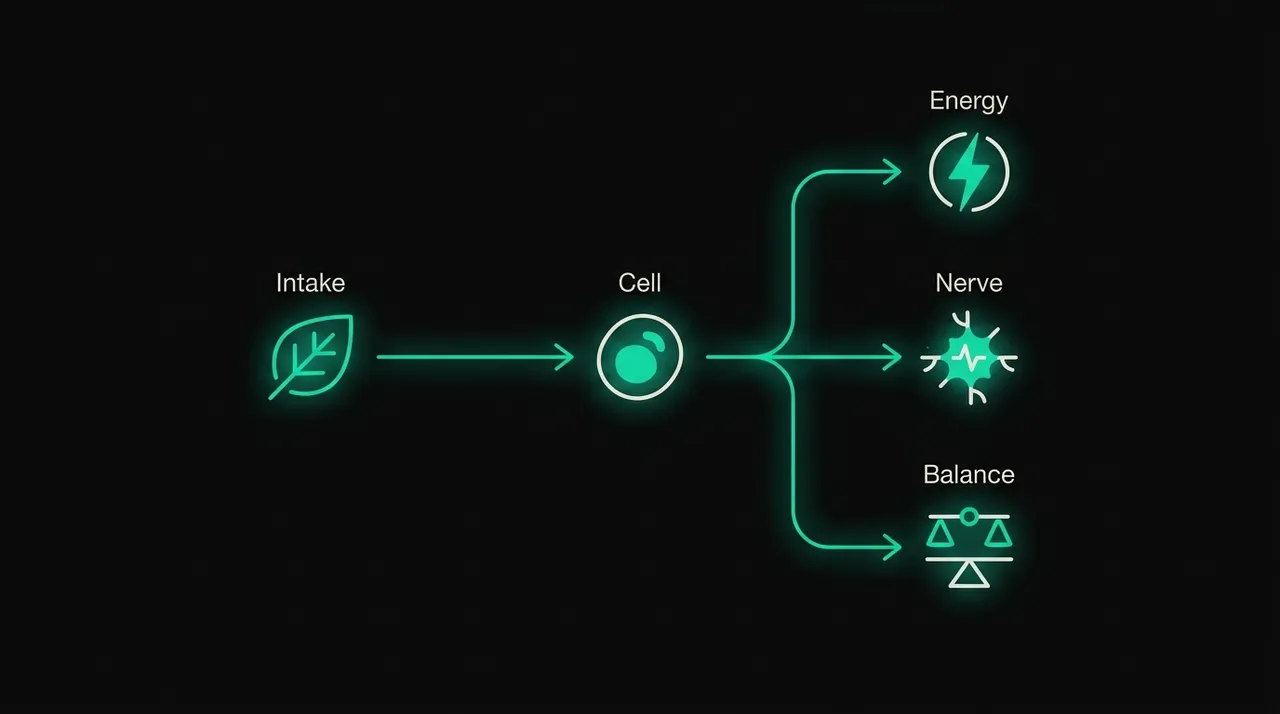
Magnesium moves from your diet into cells, where it does most of its work in energy production and nerve and muscle signaling [4]. The catch: the overwhelming majority of body magnesium sits inside cells and in bone, not in the bloodstream. So a normal serum magnesium reading doesn't rule out depletion. Acquired hypomagnesemia from medications, GI losses, and kidney handling is well documented and frequently underrecognized [8].
Genetic causes exist too. Gitelman syndrome, an inherited kidney tubule disorder, classically presents with hypomagnesemia alongside low potassium and metabolic alkalosis [5]—a reminder that persistent low magnesium sometimes points to an underlying condition rather than just diet.
This is why mineral status is worth understanding before you start guessing, and it's the same evidence-first lens we apply across our supplement science coverage.
What causes magnesium deficiency
The drivers are usually a stack of overlapping factors, not a single villain [4]:
- Diet low in whole grains and vegetables. Modern processed-food patterns are the biggest contributor [4].
- Soil depletion and food processing losses, which lower magnesium even in otherwise "healthy" foods [4].
- Restrictive diets. Plant-forward eating is generally magnesium-rich [2], but very restrictive or low-variety versions can still fall short.
- Medications, alcohol use, chronic disease, and aging, all of which increase losses or reduce absorption [4][8].
- Refeeding after malnutrition, where rapidly reintroducing calories can crash magnesium along with phosphorus and potassium—a recognized medical risk requiring monitoring [1][7].
Practical dosing
The U.S. RDA is roughly 420 mg/day for men and 320 mg/day for women [4]. Food first is the sensible default—leafy greens, legumes, nuts, seeds, and whole grains. If you supplement to close a gap, modest doses in the low hundreds of milligrams of elemental magnesium are typical, and forms like glycinate or citrate are common because they're reasonably absorbed and gentler on the gut. You can read more about how we think about magnesium as a supplement.
More is not better: excess supplemental magnesium most often just causes loose stools, and people with kidney impairment should not load magnesium without medical guidance [8].
What the evidence does NOT show
Let's be precise about the limits:
- Symptoms can't diagnose deficiency. Cramps and fatigue are consistent with low magnesium but far from proof—they have many causes [6][8].
- Magnesium is not a treatment. The evidence describes associations between deficiency and elevated risk of cardiovascular, metabolic, bone, and neuropsychiatric conditions [4]. Association is not the same as supplementation curing or preventing those conditions.
- A normal blood test isn't reassurance by itself, given how little circulating magnesium reflects total stores [8].
- "Fixing" magnesium won't fix unrelated symptoms. If the cause is sleep debt, dehydration, or something else entirely, more magnesium won't help.
Myth-check
Myth: "Muscle cramps mean you're magnesium deficient."
Reality: Cramps are associated with low magnesium, but they're also caused by overexertion, dehydration, and other electrolyte shifts [6]. Magnesium is one possible explanation, not a diagnosis. If cramps are frequent and unexplained, that's a reason to get evaluated—not to assume. The same goes for chasing better training performance: cramping is the wrong reason to reach for a tub of anything, and we've made similar points about whether beta-alanine actually works and whether creatine timing matters.
FAQ
What are the most common signs of magnesium deficiency?
Early low-magnesium symptoms tend to be nonspecific—fatigue, muscle cramps or twitches, and irritability. More severe deficiency can disrupt potassium and calcium balance. None of these are unique to magnesium, so they can't confirm a deficiency on their own [6][8].
How do I know if I actually need magnesium?
You can't reliably self-diagnose from symptoms alone. Blood tests for serum magnesium miss a lot because most of the body's magnesium sits inside cells and bone. Your intake patterns and risk factors matter more than any single symptom—talk to a clinician [4][8].
What causes magnesium deficiency?
Low intake from processed, low-vegetable diets is the most common driver, but losses from certain medications, GI conditions, alcohol use, and genetic disorders like Gitelman syndrome also matter [4][5][8].
Can a magnesium supplement fix these symptoms?
If a symptom is genuinely caused by low magnesium, restoring adequate intake may help. But magnesium does not treat, cure, or prevent disease, and supplementing won't help symptoms that have another cause [4][6].
Related reading
- Magnesium supplement overview
- Supplement science topics
- Does creatine timing matter?
- Does beta-alanine actually work?
- Does L-citrulline help with pumps?
References
- da Silva JSV et al. (2020). ASPEN Consensus Recommendations for Refeeding Syndrome. Nutrition in clinical practice : official publication of the American Society for Parenteral and Enteral Nutrition. PubMed · doi:10.1002/ncp.10474
- Craig WJ (2009). Health effects of vegan diets. The American journal of clinical nutrition. PubMed · doi:10.3945/ajcn.2009.26736N
- Passarelli S et al. (2024). Global estimation of dietary micronutrient inadequacies: a modelling analysis. The Lancet. Global health. PubMed · doi:10.1016/S2214-109X(24)00276-6
- Zhang W et al. (2025). Global Dietary Magnesium Deficiency: Prevalence, Underlying Causes, Health Consequences, and Strategic Solutions. International journal for vitamin and nutrition research. Internationale Zeitschrift fur Vitamin- und Ernahrungsforschung. Journal international de vitaminologie et de nutrition. PubMed · doi:10.31083/IJVNR46828
- Wang Y et al. (2025). Gitelman syndrome: diagnostic challenges and therapeutic strategies. Clinica chimica acta; international journal of clinical chemistry. PubMed · doi:10.1016/j.cca.2025.120432
- DiPalma JR (1990). Magnesium replacement therapy. American family physician. PubMed
- Fernández López MT et al. (2009). Refeeding syndrome. Farmacia hospitalaria : organo oficial de expresion cientifica de la Sociedad Espanola de Farmacia Hospitalaria. PubMed
- Rosner MH et al. (2023). Acquired Disorders of Hypomagnesemia. Mayo Clinic proceedings. PubMed · doi:10.1016/j.mayocp.2022.12.002
These statements have not been evaluated by the FDA. This content is educational only and is not intended to diagnose, treat, cure, or prevent any disease, and is not a substitute for professional medical advice.
Evidence Brief
Get supplement timing and safety notes as they ship.
Monthly evidence briefs. No hype, no disease claims, no influencer supplement stacks.