Magnesium L-Threonate Benefits: Honest Trial Results
A skeptical breakdown of magnesium L-threonate benefits, dosing, and trial data. We compare forms, analyze cognitive outcomes, and expose marketing hype.

Magnesium L-threonate is marketed as the ultimate brain supplement, heavily promoted for its ability to bypass the blood-brain barrier and sharpen cognition. The reality from the trials is more interesting, and more honest. While the preclinical data is highly compelling, the human clinical evidence shows a different story. The existing randomized controlled trials are small, heavily industry-funded, and sometimes rely on combination formulas rather than isolated L-threonate. Some trials show almost no meaningful separation from placebo in specific secondary outcomes like sleep. Here is what the actual data says about magnesium L-threonate benefits, stripped of the marketing hype.
What the science actually says
When evaluating magnesium l-threonate benefits, we have to look past the rodent data and examine the human randomized controlled trials. The results are a mix of statistically significant cognitive improvements and notable null findings, often obscured by conflicts of interest.
In a 2024 randomized, double-blind, placebo-controlled trial by Hausenblas et al., 80 adults aged 35-55 with self-assessed sleep problems took 1 gram per day of magnesium L-threonate or a placebo for 21 days [1]. Objective measurements taken via an Oura ring showed that the threonate group significantly improved versus placebo in deep sleep score, REM sleep score, light sleep time, and activity and readiness parameters (p < 0.05). Subjective questionnaires also reported improvements in behavior upon awakening, energy, daytime productivity, grouchiness, mood, and mental alertness. However, the study authors disclosed potential competing financial interests, which is a major flag when the placebo group conveniently declines while the intervention group maintains baseline status.
A 2026 randomized, double-blind, placebo-controlled trial by Lopresti et al. tested 2 grams per day of Magtein® in 100 adults aged 18-45 with self-reported dissatisfied sleep [9]. Over six weeks, the Magtein® group showed greater improvement in overall cognitive performance on the NIH Total Cognition Composite than placebo (p = 0.043), with larger treatment effects on working and episodic memory. Participants also showed a 7.5-year reduction in estimated brain cognitive age and improved reaction time (p = 0.031). Based on self-report, sleep-related impairment improved (p = 0.043), but there were no group differences in objective Oura ring sleep outcomes. The trial did find reduced resting heart rate (p = 0.030) and increased heart rate variability (p = 0.036), suggesting autonomic balance changes. As with several prior trials, this study received funding from Threotech Inc., the Magtein® IP holder, and the lead author is managing director of a contract research organization that has received nutraceutical funding.
A 2022 trial by Zhang et al. tested 2 grams per day of a branded combination formula containing magnesium L-threonate, phosphatidylserine, vitamin C, and vitamin D in 109 healthy Chinese adults [2]. Over 30 days, the intervention group showed significant improvements over the control group in all five subcategories of a standardized clinical memory test, as well as overall memory quotient scores. The older participants showed more improvement than younger participants. However, because this used a combination formula, we cannot attribute these cognitive outcomes solely to the L-threonate.
A 2016 trial by Liu et al. investigated a synapse density enhancer in 44 older adults (aged 50-70) with cognitive impairment [3]. The treatment group took the compound for 12 weeks. Overall cognitive ability improved significantly relative to placebo (p = 0.003, Cohen's d = 0.91). The study population had more severe executive function deficits than age-matched controls, and the intervention nearly restored their impaired executive function. Despite this large effect size, the authors noted that due to strong placebo effects on sleep and anxiety, the therapeutic effects of the compound on sleep and anxiety could not be determined. The trial was funded and conducted by the product's manufacturer.
In a 2023 randomized, double-blind, placebo-controlled trial by Ni et al., researchers evaluated 1 gram per day of magnesium L-threonate in 127 patients to assess persistent pain outcomes following breast cancer surgery [8]. The abstract indicates that researchers evaluated the therapeutic effect of supplementation but reported no numeric effect sizes, means, or p-values detailing a clinical pain reduction benefit in the provided text. This absence of quantified pain outcomes is a red flag when assessing the efficacy of the intervention for physical recovery.
Who funded the trials behind the sleep claim
Skepticism about who paid for these studies is warranted: every human trial reviewed here was run with direct involvement of the ingredient's patent holder, supplier, or manufacturer [1, 2, 3, 9]. The 21-day sleep trial lists three of six authors as affiliated with AIDP, the company that supplies Magtein®, and holds its copyright [1]. The 6-week trial was funded by Threotech Inc., the Magtein® IP holder, which co-designed the study; its lead author runs a nutraceutical-funded contract research organization [9]. The 2016 trial was funded and conducted by Neurocentria, the compound's manufacturer [3], and the 2022 trial, though it declared no competing interests, tested a branded Magtein® product [2].
Disclosed funding is transparency, not fraud. But the effect sizes above come from one interested research ecosystem with no independent replication yet, which is why our magnesium supplement overview weights reproducibility heavily.
How L-threonate may influence synapse density
To understand why magnesium L-threonate is hypothesized to support cognition, we have to look at the molecular level. Unlike magnesium glycinate or citrate, L-threonate is a specific anion that acts as a transporter.
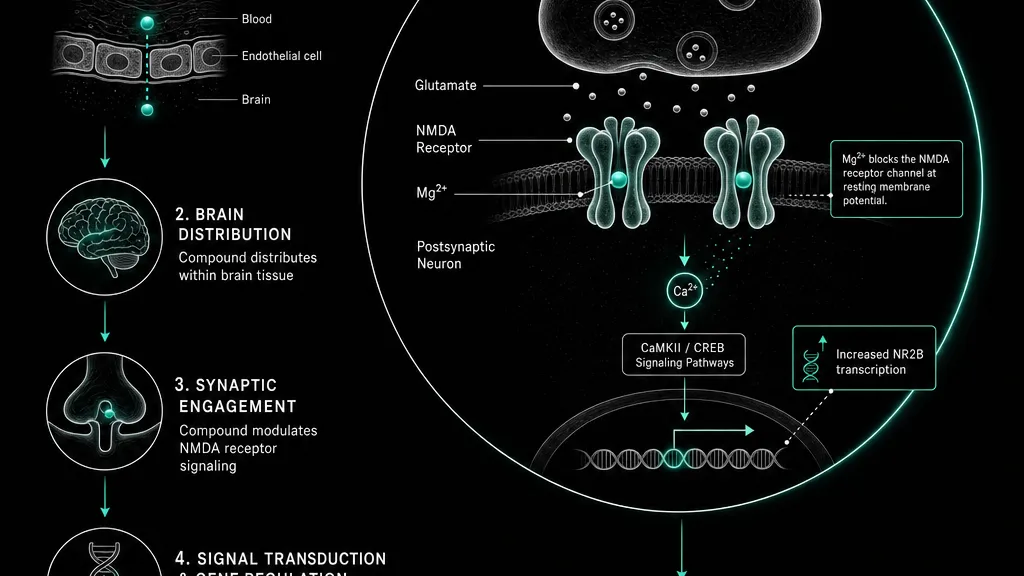
According to in vitro and animal data (hypothesis, not proof), oral administration of L-threonate actively elevates cerebrospinal fluid threonate levels, which directly induces an increase in intracellular magnesium concentration in cultured hippocampal neurons [4]. This transport mechanism is thought to be unique among magnesium salts because the threonate anion itself can cross the blood-brain barrier more readily than other common magnesium carriers. Once inside neurons, elevated magnesium is hypothesized to act as a natural NMDA receptor co-agonist, modulating synaptic signaling without the excitotoxic risks associated with direct receptor agonists. Functionally, elevating threonate upregulates the expression of NR2B-containing NMDA receptors.
A 2014 review by Wang et al. highlights that endogenous NR2B subunits decrease as the brain ages [5]. The review notes that elevated brain magnesium levels, achieved via dietary supplementation with compounds like magnesium L-threonate, may increase NR2B expression in the brain. This upregulation is believed to enhance synaptic plasticity and memory functions in preclinical models.
In mice (animal data, hypothesis, not proof), elevating brain magnesium via supplementation reduces amyloid-beta plaques and preserves synapse density in transgenic Alzheimer's disease models [6, 7]. The mechanism appears to involve the prevention of calcineurin overactivation in hippocampal slices, which stabilizes synaptic NMDA receptors. However, these structural brain changes have not been validated in human imaging trials.
Comparing magnesium forms and outcomes
A central question in the EverPrime supplement overview is that form choice, gastrointestinal tolerance, and medication spacing matter far more than the biggest elemental number on a label. This is heavily apparent when comparing L-threonate to glycinate and citrate.
If you are struggling with the decision between magnesium l-threonate vs glycinate or magnesium l-threonate vs citrate, it helps to look at the studied human outcomes side-by-side.
| Form | Primary Studied Human Outcomes | Typical Dosing in Trials | Notes |
|---|---|---|---|
| Magnesium L-Threonate | Subjective sleep quality, memory retention, cognitive function in older adults [1, 2, 3] | 1 to 2 grams per day | Lower in elemental magnesium. Studied primarily for neurological pathways. |
| Magnesium Glycinate | General systemic repletion, high GI tolerance, subjective relaxation | Varies (elemental dosing) | Often preferred for calming and avoiding loose stools. |
| Magnesium Citrate | General absorption, osmotic laxative effects | Varies (elemental dosing) | Highly bioavailable for systemic levels, but frequently causes GI distress. |
When comparing these forms, understand that L-threonate is marketed specifically for the brain. If you want to understand systemic magnesium levels, you should review the signs of magnesium deficiency. For readers weighing magnesium l-threonate vs glycinate, the decision should rest on your primary health goal: if you want trial-backed cognitive or objective sleep data, L-threonate is the only form with that specific evidence. If you want systemic repletion with minimal GI risk, glycinate remains the better-documented choice.
Practical dosing
Figuring out the correct magnesium l-threonate dosage requires understanding how these trials were structured, as well as practicing strict label literacy regarding elemental versus total compound weight.
Elemental vs. Total Magnesium: Magnesium L-threonate is a chelated compound consisting of the mineral magnesium bound to threonate. When a supplement label lists "1,000 mg Magnesium L-Threonate," it does not mean you are getting 1,000 mg of elemental magnesium. The actual elemental yield is roughly 144 mg of elemental magnesium per 1,000 mg of the compound, a ratio derived from the molecular weight of the chelate [10].
To contextualize this, the National Institutes of Health Office of Dietary Supplements states that the Recommended Dietary Allowance (RDA) for adult men is 400-420 mg per day, and for adult women is 310-320 mg per day [10]. Taking a standard 2-gram dose of L-threonate provides less than half of the daily elemental requirement for most adults. L-threonate is an expensive way to hit your systemic RDA, but it is the only form clinically studied for cognitive outcomes.
Studied Doses and Duration: Clinical trials used 1 gram per day for sleep outcomes over 21 days [1], and 2 grams per day (often split into two doses) for cognitive outcomes over 30 to 60 days [2]. One trial extended cognitive evaluation to 12 weeks [3]. Consumers asking when to take magnesium l-threonate benefits most should note that while the sleep trial provided 1 gram daily, the exact morning or evening timing is not specified in the abstract. Standard practice is to split doses or take them in the evening to accommodate the compound's relaxing profile, similar to routines used for magnesium for sleep. The key takeaway from trial durations is that measurable cognitive effects required weeks, not days, of consistent supplementation.
Tolerability and Side Effects: Across the reviewed studies, the compound was reported as safe and well tolerated [1]. However, general magnesium supplementation can lead to gastrointestinal discomfort or changes in bowel habits at higher doses. Because L-threonate contains less elemental magnesium per gram than forms like oxide or citrate, it is less likely to cause osmotic diarrhea, which is why it is often marketed as a gentler option. There is no clinical evidence supporting the internet rumors regarding magnesium l-threonate hair loss.
Medication Interactions: Because magnesium can chelate certain drugs, you must space your supplementation appropriately. If you take fluoroquinolone or tetracycline antibiotics, or bisphosphonates for bone density, standard guidance is to separate your magnesium dose by at least two hours. You can verify your specific drug timings using our dedicated mineral-antibiotic timing tool.
Who Might Benefit Most: Based on the trial populations, adults aged 50 to 70 with self-reported cognitive concerns showed the largest effect sizes (Cohen's d = 0.91) [3]. Younger healthy adults showed smaller improvements in the combination formula trial [2]. There is no evidence that L-threonate provides cognitive enhancement in individuals who already have optimal magnesium status and no cognitive complaints. Those seeking general relaxation or systemic repletion may find glycinate or citrate more appropriate for their goals. If you are unsure about your magnesium status, review the signs of magnesium deficiency before selecting a specific form.
Kidney Disease Caution: Standard medical guidance dictates that individuals with chronic kidney disease or significant renal impairment must consult a clinician before taking any magnesium supplement, as impaired kidneys cannot efficiently excrete excess magnesium, leading to potential toxicity.
What the evidence does NOT show
- It does not show magnesium L-threonate can modify, resolve, eliminate, or halt Alzheimer's disease or dementia. The human clinical trials show associations with improved cognitive test scores and memory in older adults, but these are structure/function findings, not evidence of disease modification. The animal data showing amyloid plaque reduction and synapse preservation in transgenic mice has not been replicated in human neuroimaging studies, and no trial has measured biomarkers of neurodegeneration in human participants.
- It does not show superiority over other magnesium forms for general sleep. While Hausenblas et al. showed objective Oura ring improvements in deep sleep and REM sleep [1], these findings cannot be extrapolated to prove that L-threonate is more effective at inducing sleep than magnesium glycinate or citrate. No head-to-head human trials exist in the trials reviewed here.
- It does not show any clinical evidence for supporting hair retention or addressing physical pain. Despite search trends for magnesium l-threonate hair loss, there is no data supporting its use for hair retention. The Ni et al. trial evaluating persistent pain after breast cancer surgery failed to provide quantified effect sizes or means in the provided text, making it impossible to validate claims regarding physical pain reduction [8].
- It does not show isolated L-threonate improves cognition in healthy young adults. The Zhang et al. trial showing broad cognitive improvements used a combination formula containing phosphatidylserine, vitamin C, and vitamin D alongside the magnesium [2].
Myth-check
The Popular Claim: "Magnesium L-threonate is a miracle nootropic that directly cures brain fog and reverses cognitive decline in days because it completely bypasses the blood-brain barrier."
The Reality: The trials show a much narrower, specific effect. Magnesium L-threonate is not a miracle compound. Its primary mechanism involves upregulating NR2B-containing NMDA receptors and increasing functional synapse density via elevated intracellular magnesium, which takes weeks of consistent dosing to manifest in cognitive test scores [3, 4]. The human trials are limited in sample size, often funded by the manufacturers, and heavily reliant on subjective questionnaires or combination formulas. It may support brain health, but the evidence does not support immediate, profound nootropic effects.
FAQ
What happens if you take magnesium L-threonate every day?
In clinical trials, daily supplementation of 1 to 2 grams for up to 12 weeks was generally well tolerated and associated with improvements in subjective sleep quality and cognitive test scores [1, 2, 3]. No serious adverse events were reported in the reviewed studies. Standard guidance is to cycle or periodically evaluate your supplement routine.
Which is better, magnesium glycinate or magnesium L-threonate?
They serve different purposes based on bioavailability and studied outcomes. Glycinate is often preferred for general systemic magnesium repletion and high gastrointestinal tolerance, while L-threonate is specifically studied for cognitive and sleep outcomes [1]. The choice depends entirely on your primary health goal.
Is it better to take magnesium L-threonate at night or in the morning?
The sleep trial provided participants with 1 gram per day, but the abstract does not specify the exact time of administration [1]. Anecdotally, users split doses between morning and evening, but trial-level timing data is limited.
What should not be taken with magnesium L-threonate?
Standard guidance is to separate magnesium intake from certain medications, particularly fluoroquinolone and tetracycline antibiotics, as well as bisphosphonates, because magnesium can chelate these drugs and reduce their absorption.
Does magnesium L-threonate make you sleepy?
According to one 21-day study using Oura ring measurements, L-threonate positively influenced deep sleep and REM sleep scores compared to placebo. However, it also improved daytime energy and alertness, rather than acting strictly as a sedative [1]. This suggests the sleep benefit may come from improved sleep architecture rather than direct sedation.
Are magnesium L-threonate side effects common?
The supplement was generally well tolerated in the reviewed trials, which is consistent with the GI tolerance profile of non-citrate magnesium forms. As with any mineral supplement, individuals with kidney disease should consult a clinician before use due to altered mineral clearance [1, 3].
Related reading
- Magnesium Supplement Overview: Form Choice Over Numbers
- Does Magnesium Help You Sleep Better?
- Magnesium Glycinate vs. Citrate: Which is Best?
- Choosing the Best Form of Magnesium Supplement
- Recognizing the Signs of Magnesium Deficiency
- Supplement Science Topic Hub
References
- Hausenblas HA, Lynch T, Hooper S, et al. (2024). Magnesium-L-threonate improves sleep quality and daytime functioning in adults with self-reported sleep problems: A randomized controlled trial. Sleep medicine: X. https://pubmed.ncbi.nlm.nih.gov/39252819/ doi:10.1016/j.sleepx.2024.100121
- Zhang C, Hu Q, Li S, et al. (2022). A Magtein(®), Magnesium L-Threonate, -Based Formula Improves Brain Cognitive Functions in Healthy Chinese Adults. Nutrients. https://pubmed.ncbi.nlm.nih.gov/36558392/ doi:10.3390/nu14245235
- Liu G, Weinger JG, Lu ZL, Xue F, Sadeghpour S. (2016). Efficacy and Safety of MMFS-01, a Synapse Density Enhancer, for Treating Cognitive Impairment in Older Adults: A Randomized, Double-Blind, Placebo-Controlled Trial. Journal of Alzheimer's disease : JAD. https://pubmed.ncbi.nlm.nih.gov/26519439/ doi:10.3233/JAD-150538
- Sun Q, Weinger JG, Mao F, Liu G. (2016). Regulation of structural and functional synapse density by L-threonate through modulation of intraneuronal magnesium concentration. Neuropharmacology. https://pubmed.ncbi.nlm.nih.gov/27178134/ doi:10.1016/j.neuropharm.2016.05.006
- Wang D, Jacobs SA, Tsien JZ. (2014). Targeting the NMDA receptor subunit NR2B for treating or preventing age-related memory decline. Expert opinion on therapeutic targets. https://pubmed.ncbi.nlm.nih.gov/25152202/ doi:10.1517/14728222.2014.941286
- Li W, Yu J, Liu Y, et al. (2014). Elevation of brain magnesium prevents synaptic loss and reverses cognitive deficits in Alzheimer's disease mouse model. Molecular brain. https://pubmed.ncbi.nlm.nih.gov/25213836/ doi:10.1186/s13041-014-0065-y
- Li W, Yu J, Liu Y, et al. (2013). Elevation of brain magnesium prevents and reverses cognitive deficits and synaptic loss in Alzheimer's disease mouse model. The Journal of neuroscience : the official journal of the Society for Neuroscience. https://pubmed.ncbi.nlm.nih.gov/23658180/ doi:10.1523/JNEUROSCI.4610-12.2013
- Ni Y, et al. (2023). A Randomized, Double-Blind, Placebo-Controlled Trial to Evaluate the Therapeutic Effect of Magnesium-L-Threonate Supplementation for Persistent Pain After Breast Cancer Surgery. Breast cancer (Dove Medical Press). https://pubmed.ncbi.nlm.nih.gov/37520407/ doi:10.2147/BCTT.S413435
- Lopresti AL, Smith SJ. (2026). The effects of magnesium L-threonate (Magtein®) on cognitive performance and sleep quality in adults: a randomised, double-blind, placebo-controlled trial. Frontiers in nutrition. 12:1729164. https://pubmed.ncbi.nlm.nih.gov/41601871/ PMID: 41601871. Free full text: https://pmc.ncbi.nlm.nih.gov/articles/PMC12832366/ doi:10.3389/fnut.2025.1729164
- National Institutes of Health Office of Dietary Supplements. (2024). Magnesium: Fact Sheet for Health Professionals. https://ods.od.nih.gov/factsheets/Magnesium-HealthProfessional/
Statements regarding magnesium L-threonate have not been evaluated by the Food and Drug Administration. This information is for educational purposes only and is not a substitute for professional medical advice. EverPrime does not claim that any supplement can modify, resolve, or eliminate any disease. Always consult a qualified healthcare provider before starting a new supplement, especially if you have a medical condition, take prescription medications, or have kidney impairment.
Evidence Brief
Get supplement timing and safety notes as they ship.
Monthly evidence briefs. No hype, no disease claims, no influencer supplement stacks.