Your magnesium might be blocking your antibiotic: the timing rule most doctors don't mention
When magnesium and certain antibiotics meet in your gut, the antibiotic can lose most of its absorption. Here's what the research shows — and the spacing rule that fixes it.
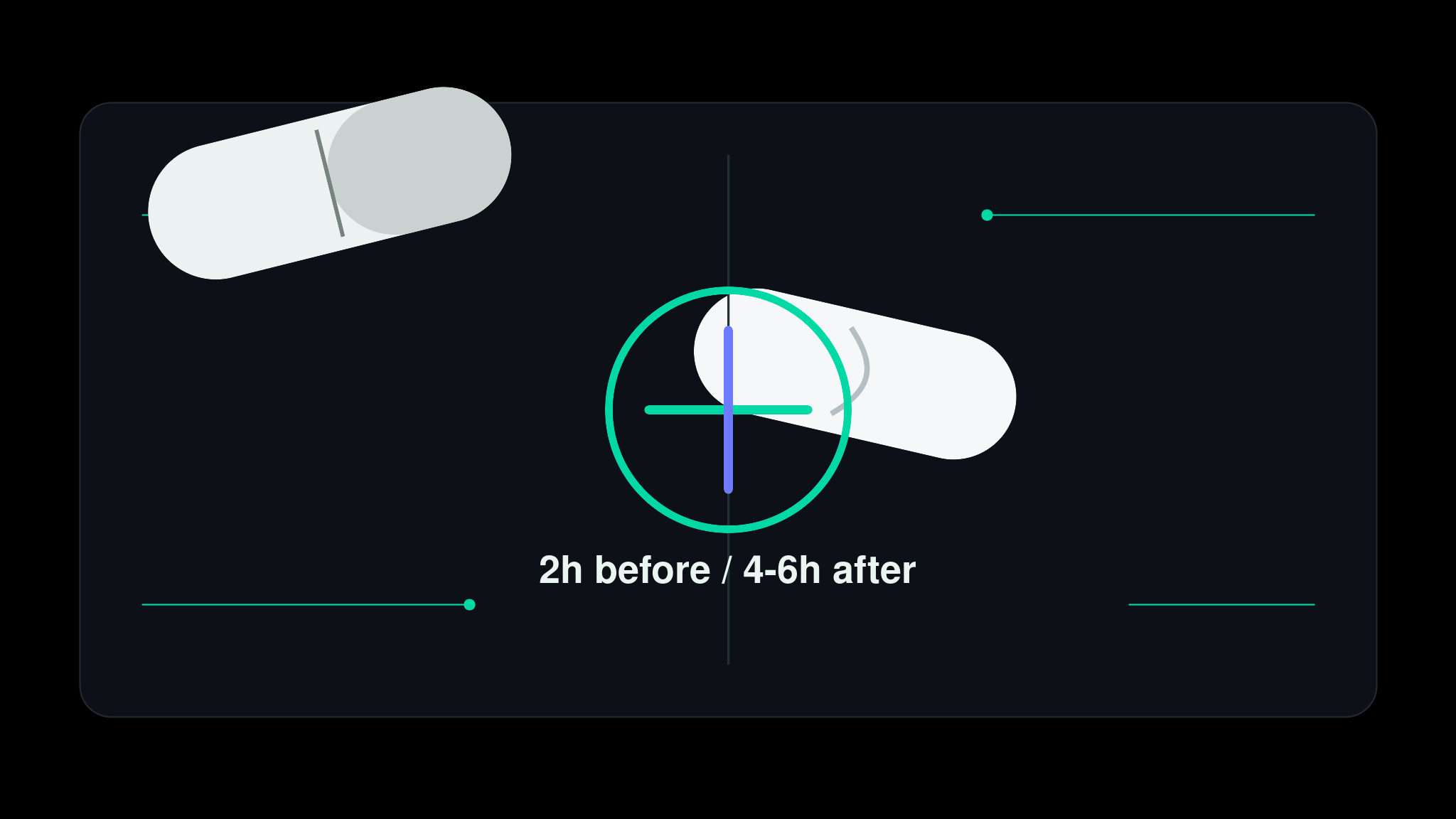
Yes — taking magnesium with a fluoroquinolone antibiotic like ciprofloxacin or with a tetracycline like doxycycline can substantially reduce the antibiotic's absorption. Magnesium ions chelate with the drug in your gut, forming a complex your body can't absorb. The fix is timing: take magnesium at least 2 hours before, or 4 to 6 hours after, the antibiotic. The same rule applies to calcium, iron, zinc, and aluminum-containing antacids. Studies report that chelation interactions affect 22–76% of patients prescribed fluoroquinolones, though most prescribers don't mention the timing rule (PMID 7669261).
Key takeaways
- Magnesium and a class of antibiotics called fluoroquinolones (ciprofloxacin, levofloxacin, moxifloxacin, others) interact via chelation in the gut, which can substantially reduce antibiotic absorption.
- The interaction is well-documented in pharmacokinetic studies. One controlled study found polyvalent metal cations including magnesium cause measurable absorption decreases of fluoroquinolones (PMID 24806820). Computational models predict substantial bioavailability reductions even with moderate cation concentrations (PMID 33919271).
- The standard timing guidance: take magnesium at least 2 hours before the antibiotic, or 4 to 6 hours after the antibiotic.
- Other supplements and over-the-counter products with the same chelating behavior include calcium, iron, zinc, and aluminum-containing antacids — the same timing rule applies.
- This is not a reason to stop taking either the supplement or the antibiotic. It is a reason to time them carefully.
Mechanism map
Why the same gut window is the problem
Mineral ion
Mg2+
Divalent cations can bind certain antibiotic structures before the medication crosses the intestinal wall.
Gut chelate complex
The combined complex is less soluble, so less drug crosses into circulation.
Antibiotic exposure
AUC ↓
The bound complex is less available for absorption, which can reduce peak exposure and total antibiotic exposure.
Why does magnesium block fluoroquinolone antibiotics?
Fluoroquinolone antibiotics work by inhibiting bacterial enzymes called DNA gyrase and topoisomerase IV. The class includes ciprofloxacin (Cipro), levofloxacin (Levaquin), moxifloxacin (Avelox), ofloxacin, and several others. They are commonly prescribed for urinary tract infections, certain respiratory infections, and some skin and bone infections.
The interaction with magnesium is a pharmacokinetic one, not a pharmacodynamic one — meaning it doesn't change how the antibiotic acts against bacteria once absorbed; it changes how much actually gets absorbed in the first place.
What's the underlying chelation mechanism?
Magnesium is a divalent cation (Mg²⁺). Fluoroquinolone antibiotics contain a 4-oxoquinoline-3-carboxylic acid structural motif that readily binds divalent and trivalent metal cations. When the two meet in the gastrointestinal tract, they form an insoluble chelate complex. Insoluble means the body can't absorb it across the intestinal wall. So instead of antibiotic going into your bloodstream, you get an antibiotic-magnesium complex passing through and out.
In a 2014 pharmacokinetic study (Imaoka et al., PMID 24806820), the authors investigated the contribution of chelation and physicochemical adsorption to the absorption decrease seen with polyvalent metal cation products. They concluded that the absorption reduction was not fully attributable to chelation or adsorption alone, suggesting additional mechanisms — but the practical takeaway for patients is unchanged: cation-containing products taken concurrently with these antibiotics measurably reduce absorption. A 2019 review analyzing clinical relevance concluded these interactions remain clinically significant and warrant continued spacing guidance (PMID 6784105).
Earlier work in the 1990s established the clinical magnitude of the effect with various magnesium and aluminum antacid preparations. Magnitude varies considerably across studies depending on the specific antibiotic, the metal cation source, the dose, and the timing of co-administration — but the direction is consistent: concurrent magnesium reduces fluoroquinolone absorption. A 2021 computational study modeling magnesium, calcium, and aluminum chelation with fluoroquinolones showed substantial reduction in absorption rate and bioavailability (PMID 33919271). The 2014 Imaoka et al. work cited above is one of the more recent investigations of the underlying mechanism. For a specific numerical magnitude in your situation, your prescribing clinician or pharmacist is the right source — they have access to the relevant product-specific data.
Why does reduced absorption matter clinically?
Antibiotic absorption is not just an academic concern. The antimicrobial effect of fluoroquinolones depends on achieving and maintaining concentrations above the minimum inhibitory concentration (MIC) for the target bacteria, often expressed as the AUC/MIC or peak/MIC ratio. Reduced absorption means lower peak blood levels, lower AUC, and potentially sub-therapeutic dosing.
Sub-therapeutic dosing is a problem for two reasons. First, the infection may not be cleared, which can prolong illness. Second, sub-therapeutic exposure is one of the conditions that selects for antibiotic resistance — bacteria that survive a low-dose exposure can develop reduced susceptibility, contributing to broader resistance issues. The clinical significance is underscored by studies showing up to 90% reduction in ciprofloxacin AUC when co-administered with aluminum/magnesium antacids (PMID 7669261). Inappropriate separation timing can lead to clinical failure by reducing bioavailability enough to fall below the minimum inhibitory concentration needed for effective treatment.
How should I schedule magnesium during an antibiotic course?
The fix is timing, not avoidance. You don't need to stop taking your magnesium supplement during a course of antibiotics, and you don't need to choose between the two. You just need to space them.
| Supplement / OTC | Timing relative to fluoroquinolone |
|---|---|
| Magnesium (any form) | 2 hours before OR 4-6 hours after |
| Calcium | 2 hours before OR 4-6 hours after |
| Iron supplements | 2 hours before OR 4-6 hours after |
| Zinc | 2 hours before OR 4-6 hours after |
| Aluminum-containing antacids | 2 hours before OR 4-6 hours after |
| Multivitamins (most contain cation minerals) | 2 hours before OR 4-6 hours after |
The "2 hours before / 4-6 hours after" rule reflects two pharmacokinetics: how long it takes for one substance to clear the stomach, and how long it takes for the antibiotic to be absorbed once it arrives. Examine.com's clinical guidance puts the conservative recommendation at 2 hours before or 4-6 hours after, with the note that the ideal window can vary by specific medication (examine.com magnesium safety). A 2021 nanopore study demonstrated dynamic magnesium-fluoroquinolone interactions that alter antibiotic transport kinetics (PMC 8162440), supporting the spacing rationale.
Timing window
The mineral spacing rule at a glance
What does a real-world dosing schedule look like?
A typical real-world schedule for someone taking magnesium twice daily and ciprofloxacin twice daily:
- 8:00 AM — Magnesium dose 1 (with breakfast)
- 10:00 AM — Ciprofloxacin dose 1 (2 hours after magnesium)
- 4:00 PM — Magnesium dose 2 (6 hours after antibiotic — clear)
- 6:00 PM — Ciprofloxacin dose 2 (2 hours after the afternoon magnesium)
Day plan
A two-dose antibiotic day can still fit magnesium
8:00 AM
Magnesium
2h before antibiotic
10:00 AM
Antibiotic
absorbs without the mineral dose
4:00 PM
Magnesium
6h after antibiotic
6:00 PM
Antibiotic
2h after magnesium
If you take magnesium only at bedtime for sleep support, you may not need to adjust at all — your antibiotic dose times likely fall in the safe windows by default. The interaction is most relevant when both are taken multiple times daily.
What if you've already been taking them together?
If you took your antibiotic and supplement at the same time for a few doses already, talk to your prescriber. They may want to extend the course, switch antibiotics, or check on the infection's response. Clinical reviews note that patient education about proper spacing is often lacking, leading to inadvertent co-administration (PMID 6784105). Don't stop the antibiotic on your own — incomplete courses are the worst-case scenario for both your recovery and antibiotic resistance.
What are the most common timing mistakes?
A few patterns we see often:
- Taking magnesium with the morning multivitamin when the multi also contains calcium, iron, zinc, and other cation minerals. The interactions stack — every cation in the same dose adds to the absorption hit. If you're on a fluoroquinolone course, separate the multi from the antibiotic too.
- Drinking milk or fortified plant milks with the antibiotic. Dairy milk contains calcium; many fortified plant milks (almond, oat, soy) add calcium. Same chelation problem. Take fluoroquinolones with water, separated from dairy and fortified beverages.
- Mineral water at the same time as the antibiotic. Hard mineral water can contain enough magnesium and calcium to matter. Use filtered or low-mineral water for the antibiotic dose.
- Antacids for stomach upset during the antibiotic course. Most over-the-counter antacids contain magnesium hydroxide, calcium carbonate, or aluminum hydroxide. They all interact. If you need stomach support during a fluoroquinolone course, ask your prescriber about an H2 blocker like famotidine instead, which doesn't have the cation-chelation problem.
- Discontinuing the magnesium entirely. Unless your prescriber specifically asks you to stop, you don't have to. Spacing the doses solves the problem.
FAQ
Does this interaction apply to all antibiotics or only some?
The strongest evidence and largest effect is for fluoroquinolones (ciprofloxacin, levofloxacin, moxifloxacin, ofloxacin, and others ending in -floxacin). Tetracycline-class antibiotics (doxycycline, minocycline, tetracycline) have the same chelation problem and the same timing rule applies. A systematic review found separation times of 2 hours before or 6 hours after for ciprofloxacin, and 4 hours before or 8 hours after for moxifloxacin, when co-administered with multivalent cations (PMC 8626210). Most other antibiotic classes (penicillins, cephalosporins, macrolides like azithromycin) are not significantly affected by magnesium, though always check with your prescriber.
What about magnesium glycinate or magnesium L-threonate? Are those safer?
The chelation interaction is driven by the magnesium ion (Mg²⁺) itself, not the salt form. So magnesium glycinate, citrate, oxide, chloride, threonate, and any other oral magnesium salt all share the interaction. Form matters for bioavailability and side effects but not for this specific interaction. A 2021 in vitro study showed magnesium complexation by fluoroquinolones impairs antibacterial properties regardless of magnesium form (PMC 188290).
Is there a magnesium form that doesn't interact?
Topical magnesium (Epsom salt baths, magnesium oil applied to skin) doesn't reach the GI tract in meaningful quantities and therefore doesn't chelate antibiotics. But evidence for meaningful systemic absorption from topical magnesium is limited; you may not be getting much magnesium that way to begin with. For supplementation effect, oral remains primary, with the timing rule applied.
How long does the interaction last?
The interaction is acute — it only matters when magnesium and the antibiotic are in the gut at the same time. Once both have been absorbed or cleared, there's no ongoing effect. That's why timing-based separation works.
My prescription says "take with food." Doesn't that include magnesium-rich foods?
"Take with food" typically refers to a small meal or snack to reduce stomach upset, not specifically to mineral-rich foods. Most prescribers don't have a magnesium-containing meal in mind. Plain food (bread, crackers, rice, eggs, meat) is fine. Avoid dairy, mineral-fortified products, and a magnesium supplement in the same window.
What about IV antibiotics?
The chelation interaction is a gut-absorption issue. IV antibiotics bypass the gut entirely, so this specific interaction does not apply. This is supported by pharmacokinetic principles where the chelation occurs in the gastrointestinal lumen before absorption. There are other interactions to consider with IV fluoroquinolones, but oral magnesium doesn't present the same absorption barrier.
Does this affect over-the-counter fluoroquinolones?
Fluoroquinolones are prescription-only in the United States, Canada, and the UK. There are no over-the-counter fluoroquinolones in these markets. If you're outside these markets and have access to OTC fluoroquinolones, the same timing rule applies — and a pharmacist or clinician should be involved in any antibiotic decision.
Bottom line
Magnesium and fluoroquinolone antibiotics interact via gut chelation. The interaction is well-established in the pharmacokinetic literature and can substantially reduce antibiotic absorption when the two are taken concurrently. The fix is to space them: magnesium 2 hours before, or 4-6 hours after, the antibiotic. The same rule applies to calcium, iron, zinc, aluminum-containing antacids, and most multivitamins. If you have an active prescription, talk to your prescriber about the timing of your supplements during the course.
EverPrime tracks this interaction in our app's interaction engine, along with the other 41 documented supplement-medication and supplement-supplement interactions in our database. If you want EverPrime to flag this kind of timing problem automatically based on your current stack and any medications you've added, download EverPrime on iOS (Android coming soon).
For deeper context on magnesium itself — forms, doses, benefits beyond this one interaction — browse the rest of the EverPrime blog.
Pending medical review. We are partnering with board-certified clinicians to formalize this credit — see /about/medical-review for status.
These statements have not been evaluated by the FDA. Not intended to diagnose, treat, cure, or prevent any disease.
Generated with AI assistance and based on published, peer-reviewed sources. Always verify with a healthcare professional, especially during an active medication course.
Educational information only. Not a substitute for professional medical advice.
Evidence Brief
Get supplement timing and safety notes as they ship.
Monthly evidence briefs. No hype, no disease claims, no influencer supplement stacks.